Leadership is one of the most requested and least well-demonstrated qualities on a finance resume. Candidates write "strong leadership skills" or "managed a team of 8" and assume the point is made. It isn't. Hiring managers have read those lines hundreds of times, and they say almost nothing about how you lead, what you changed, or what the team achieved under you.
The good news is that leadership in finance doesn't require a big title. It shows up in how you drive projects, develop people, influence decisions and take ownership of outcomes. This guide shows you how to find your leadership evidence and present it so it's credible and specific.
1. Leadership Is Broader Than Managing People
Many finance professionals think they have no leadership experience because they've never had direct reports. In reality, finance leadership takes several forms:
- People leadership: hiring, coaching, developing, restructuring and retaining teams
- Project leadership: leading ERP migrations, system implementations, process redesigns or integrations
- Functional leadership: owning a process or function end to end (close, forecasting, treasury, compliance)
- Influence without authority: persuading executives or business units to change decisions based on your analysis
- Strategic leadership: shaping capital allocation, pricing, M&A or cost transformation
- Mentorship and knowledge leadership: training analysts, building playbooks, onboarding new hires
If you've done any of these, you have leadership experience worth showcasing.
2. Show Scale First
Leadership claims gain weight when the reader can see the size of what you led. Anchor each leadership bullet with at least one scale indicator:
- Team size and structure (direct and indirect reports, locations, seniority mix)
- Budget or revenue responsibility
- Number of entities, regions or business units
- Project size, duration and cross-functional participants
- Transaction or decision value
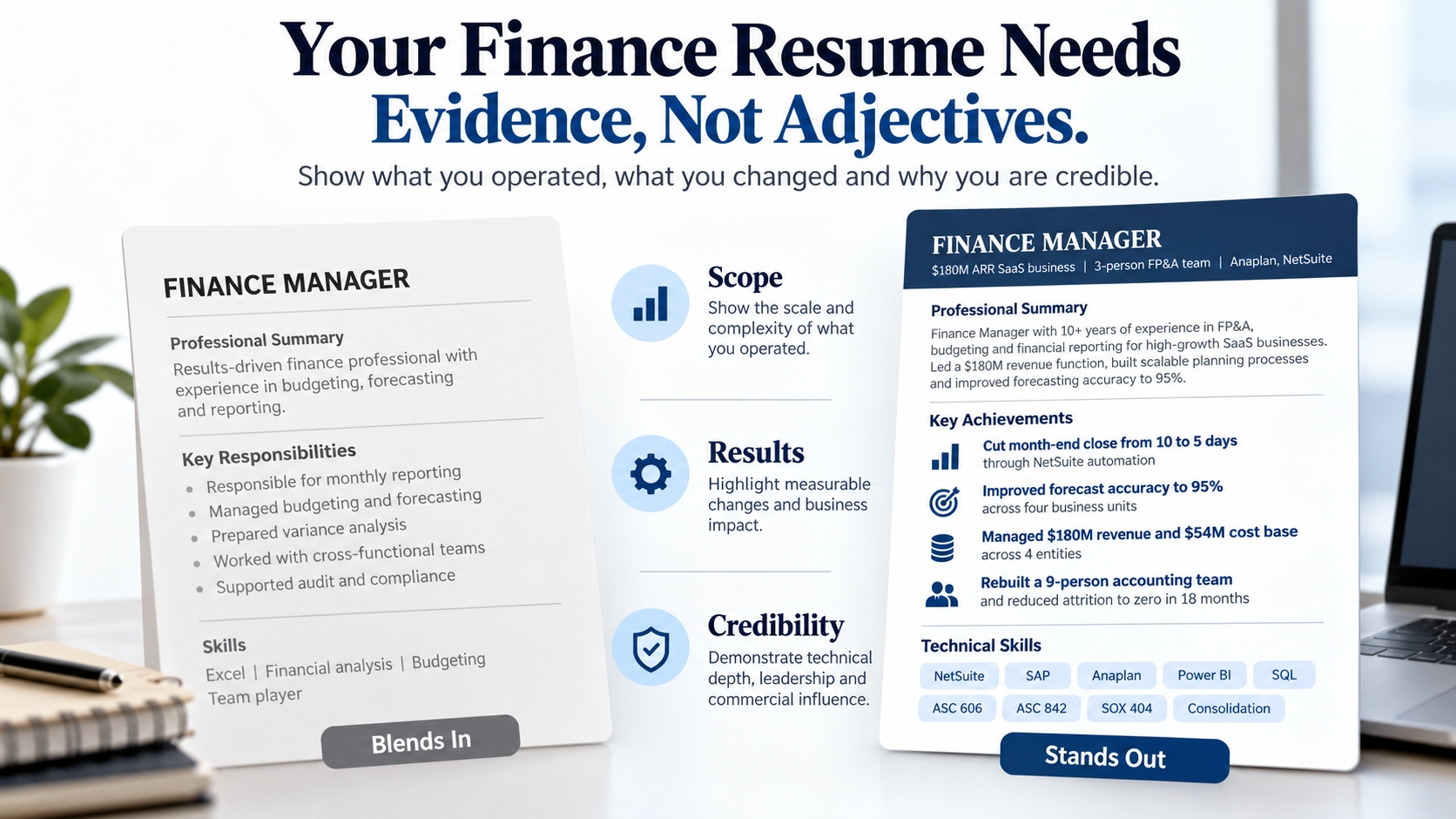
Without scale: "Led the finance team." With scale: "Led a 12-person finance team across 3 regions supporting $400M in revenue, reporting directly to the CFO."
3. Use the Leadership Formula: Situation + Action + Result
Strong leadership bullets follow a simple pattern:
- Situation: what challenge or opportunity did you face (a struggling team, a broken process, a high-stakes deadline)?
- Action: what did you specifically do as the leader?
- Result: what changed, measured in numbers wherever possible?
Example:
Inherited a demoralized 9-person accounting team with 35% annual attrition; introduced career paths, quarterly coaching and a rotation program, reducing attrition to 10% within 12 months and promoting three team members.
4. Highlight the Types of Leadership Evidence Recruiters Value Most
People development
- Promotions you drove or supported
- Attrition reduced and engagement improved
- Team members who went on to larger roles
- Hiring and onboarding improvements (time to hire, time to productivity)
Change leadership
- ERP, consolidation or reporting system implementations
- Process redesign across teams or geographies
- Post-acquisition integrations and restructuring
Business partnership and influence
- Decisions you changed through analysis
- Executive or board presentations you led
- Cross-functional initiatives with Sales, Operations, Legal or Product
Results under pressure
- Turnarounds, crises or tight-deadline deliveries
- Audit, IPO or funding-round readiness
- Cost reduction programs
Ownership and accountability
- Functions or processes you built from scratch
- Clean audits and compliance records
- Budgets you owned and delivered against
5. Use Leadership Verbs That Signal Ownership
The verb tells the reader how much you owned. Compare:
| Passive or task verbs | Leadership verbs |
| Assisted, Helped, Supported | Led, Directed, Spearheaded |
| Participated in | Drove, Championed, Owned |
| Worked on | Built, Launched, Established |
| Was responsible for | Transformed, Restructured, Scaled |
| Handled | Mentored, Coached, Developed |
Be honest with attribution. If you co-led, say so. "Co-led" with a clear description of your piece is more credible than a claimed solo result.
6. Showcase Leadership Without a Formal Title
If you haven't held a manager title, put these in your resume:
- Project lead roles: "Led the finance workstream for a $4M ERP migration involving 25 stakeholders across 5 departments."
- Informal team leadership: "Trained and onboarded 6 new analysts, reducing time to productivity from 12 to 8 weeks."
- Cross-functional influence: "Presented pricing recommendations to the executive team, resulting in a 3% margin improvement."
- Process ownership: "Owned the monthly consolidation process across 7 entities, cutting reporting time by 30%."
- Committees and initiatives: "Chaired the finance transformation steering group for the 2025 automation program."
Titles lag responsibility in many finance careers. Let your bullets show the true scope.
7. Examples by Career Stage
Early career (no direct reports)
Led a cross-functional project to automate weekly sales reporting, working with IT and Sales Ops, saving about 300 hours per year and earning selection for the company's high-potential program.
Mid-career (team lead / manager)
Managed a 6-person FP&A team supporting 4 business units and $250M in revenue; introduced a driver-based forecast that improved accuracy from ±18% to ±5% and developed two analysts into senior roles.
Senior (director / VP)
Led a 14-person finance organization through two acquisitions, standardizing close and reporting across 6 entities, releasing $18M in working capital and presenting integration results to the board.
Executive (CFO / VP Finance)
Directed the finance function for a $1.2B business, leading a cost transformation that delivered $35M in annual savings while building a finance leadership bench that filled three vacancies internally.
8. Where to Put Leadership on Your Resume
- Summary: mention team size, scope and your leadership style in one line.
- Experience bullets: place your strongest leadership proof early in each role.
- A dedicated "Leadership & Initiatives" section: useful if you have significant project, committee or mentoring work outside your formal title.
- Board, committee and volunteer roles: include relevant ones such as treasurer of a nonprofit, audit committee member or industry association leader.
- Cover letter and LinkedIn: reinforce the same two or three leadership stories consistently.
9. Common Mistakes to Avoid
- Using empty claims: "Strong leader" or "excellent team player" without evidence.
- Listing team size only: the headcount alone says nothing about how you led.
- Claiming sole credit: overclaiming team results damages credibility in interviews.
- Ignoring people outcomes: leaders are judged on their teams' growth as well as numbers.
- Burying leadership: if leadership is key for the target role, it shouldn't appear in the last bullet.
- Being vague about your role: state whether you led, co-led or contributed.
- Forgetting the business result: people leadership should connect to performance, retention or delivery.
10. A Quick Worksheet to Find Your Leadership Stories
For each role, ask yourself:
- Who did I lead, coach, train or influence, formally or informally?
- What team, project or process did I own?
- What problem or change did I tackle, and what was the situation before?
- What specific actions did I take that others did not?
- What improved (numbers, retention, speed, quality, risk)?
- What did my team or stakeholders say about the outcome?
Choose your three to five strongest answers and turn them into bullets using Situation + Action + Result.
Quick Self-Audit
- [ ] Does each leadership bullet include a scale indicator (team size, budget, entities, project value)?
- [ ] Does it describe what you did, not just the team's output?
- [ ] Does it include a measurable result?
- [ ] Have you included people-development evidence (promotions, retention, coaching)?
- [ ] Have you shown leadership beyond direct reports (projects, influence, ownership)?
- [ ] Have you used leadership verbs and avoided "assisted" or "helped"?
- [ ] Is your role (led, co-led, contributed) clearly stated?