Most finance professionals who get passed over for interviews are not underqualified. They are under-documented. The experience is real, but the resume hides it behind vague duties, missing scope, and small errors that carry outsized weight in a function where accuracy is the job.
As a corporate recruitment search firm, we see this pattern daily across Controller, FP&A, Finance Director, and VP-level searches. A resume that would have earned a conversation gets set aside, and the candidate never learns why.
Below are the 12 mistakes we see most, each with a before-and-after fix. Use it as a checklist against your own resume.
Mistake 1: Listing Duties Instead of Outcomes
This is the most common problem, and it shows up in nearly every finance-specific resume guide for a reason. A duty tells the reader what your job description said. An outcome tells them what changed because you held the seat.
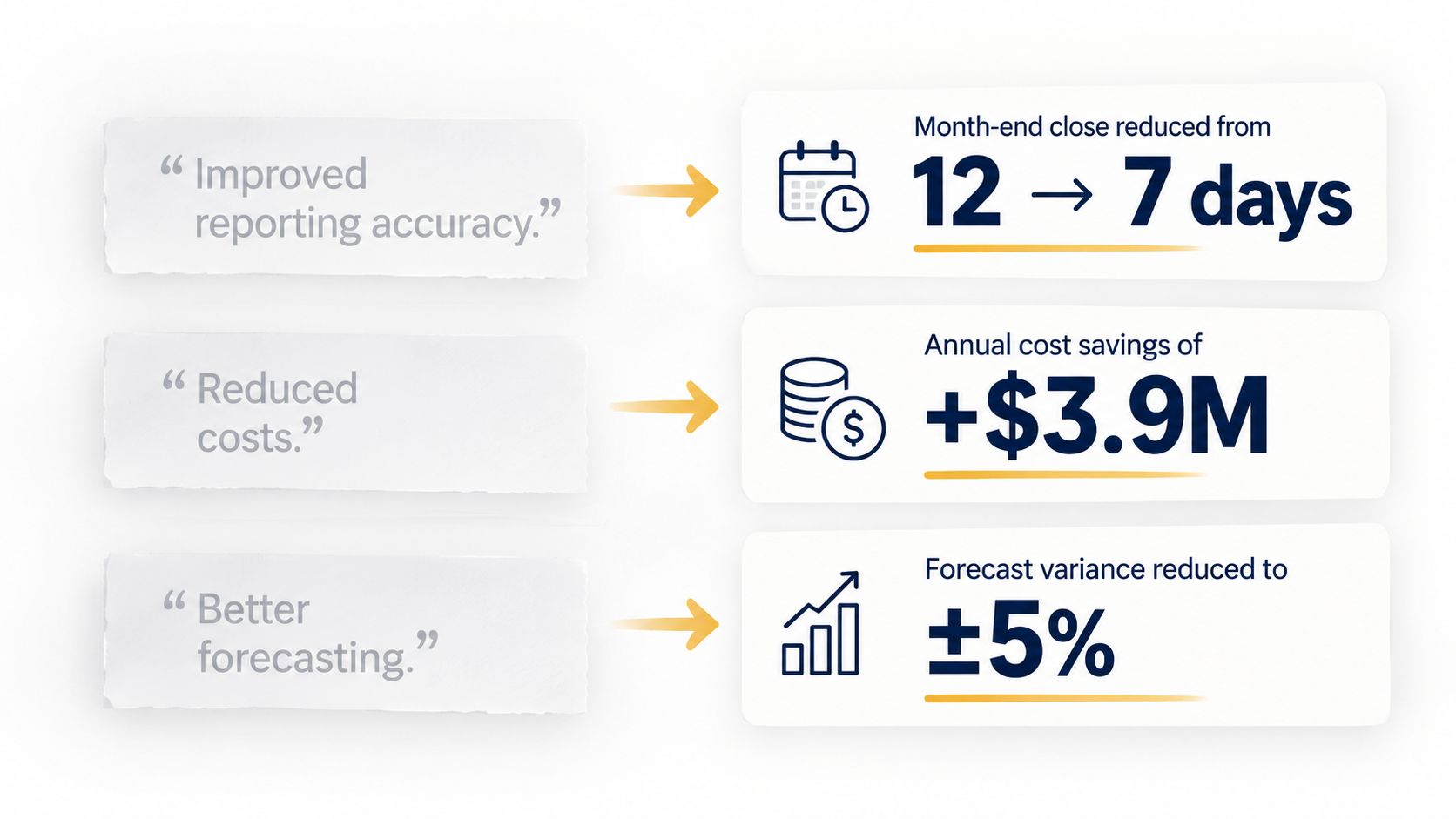
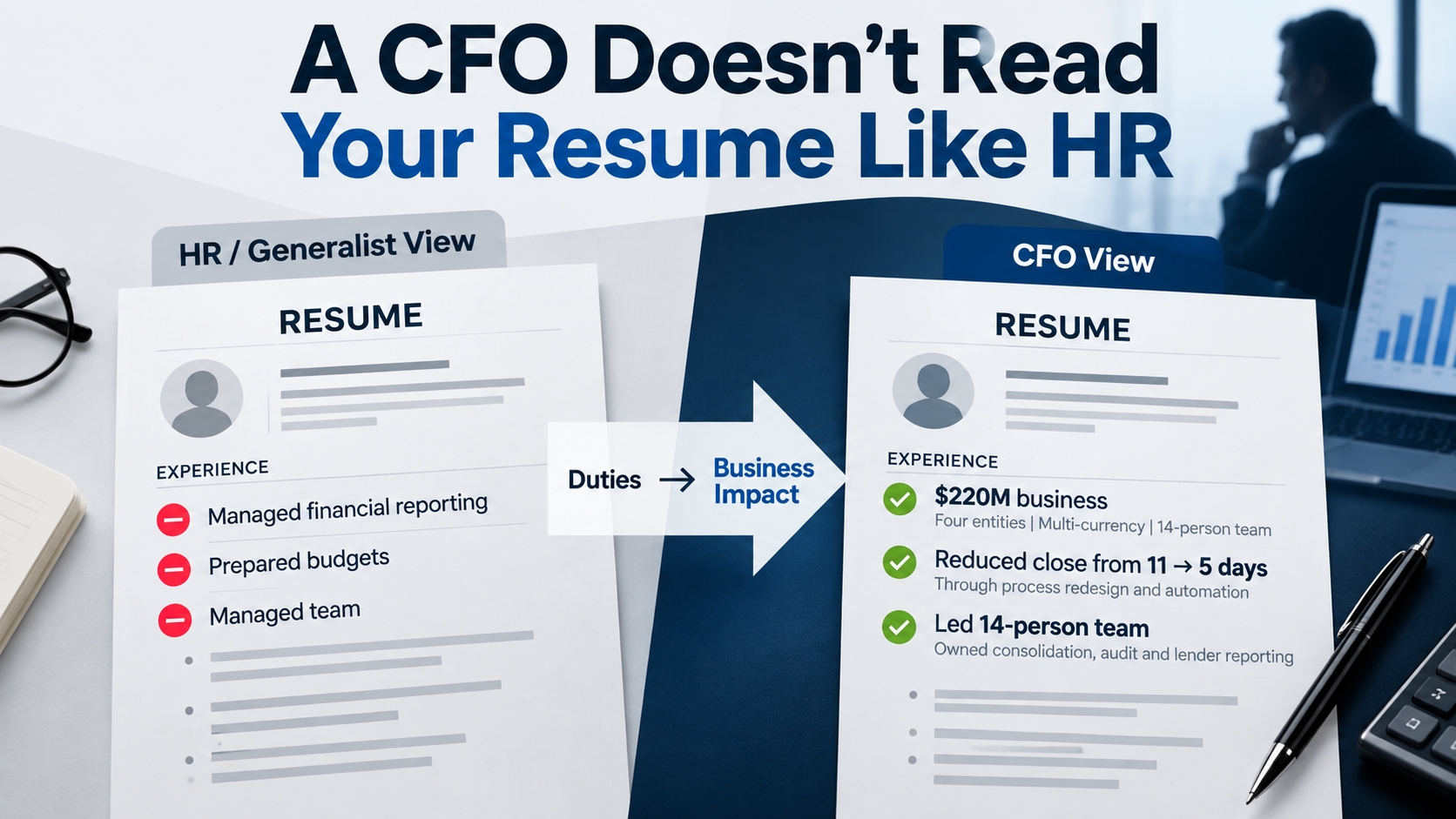
Before: "Responsible for month-end close and financial reporting." After: "Cut month-end close from 10 to 5 business days by redesigning the close calendar and automating intercompany reconciliations."
Fix: Use the pattern action + process or system + measurable result. If a bullet could appear unchanged on a colleague's resume, it is a duty.
Mistake 2: Leaving Out Scope
A Controller at a $15M single-entity company and a Controller at a $300M multi-entity group hold the same title and very different jobs. If your resume does not say which one you were, the reader has to guess, and they usually guess low.
Before: "Controller, ABC Manufacturing." After: "Controller, ABC Manufacturing ($220M revenue, 4 entities, US and Mexico; led a 14-person team; NetSuite)."
Fix: State revenue, entity count, team size, budget owned, and ERP in the first line or two of each role. If figures are confidential, use ranges.
Mistake 3: Bullets With No Numbers
Finance is a numbers function, so a bullet with no number reads as a gap in your own field. Hiring managers consistently name missing quantified results among the weaknesses they notice.
Before: "Improved forecasting accuracy." After: "Rebuilt the quarterly forecast model, reducing variance to actuals from 11% to 4%."
Fix: Aim for a metric in most bullets: dollars, percentages, days, headcount, basis points, or deal size. If you cannot measure it, describe the scale instead ("across 12 cost centers").
Mistake 4: Typos and Number Errors
In most roles a typo is a minor flaw. In finance it is evidence. A misformatted date, inconsistent decimal, or total that does not reconcile suggests the same carelessness could appear in a model, a close package, or a board deck.
Surveys of hiring managers regularly name spelling and grammar errors as a leading reason for rejection, though specific percentages vary by study and are often quoted secondhand. The direction is consistent enough to take seriously.
Fix: Check every figure against your records, keep date formats consistent (MM/YYYY throughout), and have someone outside finance read it for typos. Read it once backward to catch what your eye skips.
Mistake 5: Skills Lists That Say Nothing
"Excel," "financial reporting," "team player," and "detail-oriented" appear on almost every finance resume. Recruiters and screening systems discount them because they carry no proof.
Before: Excel, financial analysis, budgeting, team player After: NetSuite, SAP, Anaplan, Power BI, SQL, ASC 606, ASC 842, SOX 404, variance analysis, 13-week cash forecasting, consolidation
Fix: List named systems and technical standards, mirror the wording of the job posting where it is true, and make sure each skill is backed by a bullet. Assume you will be asked about everything on the list.
Mistake 6: One Resume for Every Job
Finance titles overlap but roles differ. A Senior Financial Analyst in SaaS FP&A and a Senior Financial Analyst in corporate treasury emphasize different skills, and recruiters filter on that difference.
Fix: Keep a master resume and tailor the summary, the top three bullets of your current role, and the skills section for each application. Include the target title in your summary so the match is obvious. Match wording only where you genuinely have the experience, because keyword stuffing survives a parser and fails an interview.
Mistake 7: A Weak or Generic Summary
Many finance resumes open with "results-driven finance professional with a proven track record." Recruiters have read that sentence thousands of times, and it also signals unedited AI-generated text, which hiring teams increasingly notice.
Before: "Results-oriented finance leader with extensive experience in budgeting, forecasting, and team management." After: "Finance Director leading a 9-person FP&A and accounting team for a $250M business unit. Built the company's first rolling 13-week cash model and led finance integration for two acquisitions."
Fix: Use role + scope + one headline result. Replace adjectives with facts.
Mistake 8: Senior Resumes That Still Read Like Individual Contributor Resumes
At Director and VP level, the most common problem is not vague language. It is bullets that describe work you did personally when the role requires you to lead, influence, and decide. A Director whose bullets match what they wrote as a Manager looks stalled.
Before: "Prepared the annual budget and monthly variance reports." After: "Led the annual budget for 12 departments, shortened the cycle by three weeks, and presented variance findings to the CEO and board audit committee each quarter."
Fix: Show team building, cross-functional influence, executive or board exposure, and strategic ownership (capital structure, M&A, systems, lender relationships).
Mistake 9: Every Role Sounds the Same
When bullets repeat across jobs, the reader concludes you did the same work for ten years, or that you do not remember your own impact. Either reading hurts.
Fix: Show increasing scope from role to role. Keep detailed bullets for the last 10 to 15 years and summarize earlier roles in a line or two. Three achievements you can defend beat ten you cannot.
Mistake 10: Leaving Gaps, Short Tenures, or Transitions Unexplained
At senior levels, hiring teams are assessing trust with financial controls, not just competence, so unexplained gaps draw more questions. A short tenure with no context invites the worst assumption.
Before: A blank 14-month gap. After: "Fractional Controller for two portfolio companies, managing close and audit prep; completed CPA license renewal." Or, for a short stint: "Role eliminated in post-acquisition restructuring."
Fix: Address gaps and short tenures in one factual line. Do not over-explain and do not leave the reader to guess.
Mistake 11: Formatting That Hides Your Best Material
Heavily designed templates with columns, text boxes, icons, and tables often parse poorly. Skills and metrics can be scrambled or dropped by the software before a person sees them. Cluttered layouts also make the document harder for humans to scan.
A note on perspective: claims that most resumes are auto-rejected by software are overstated, and many systems do not reject on formatting alone. The practical risk is that poor parsing makes you harder to find and harder to read, not that you are deleted.
Fix: Use a single-column layout, standard headings (Summary, Experience, Skills, Education), consistent dates, and a text-based PDF or Word file. Keep a senior resume to two pages.
Mistake 12: Overstating, Inflating, or Making Claims You Cannot Back Up
Finance hiring involves reference checks, background screening, and detailed interview questions about your numbers. Inflated titles, rounded-up results, and credited work you did not lead tend to surface, and in a trust-based function that ends the process.
Fix: Claim what you personally drove. Use "contributed to" or "partnered with" where credit is shared. Be ready to explain the method behind every number on the page.
Quick Reference: Mistake and Fix
| Mistake | What the reader concludes | Fix |
| Duties, not outcomes | You did the job, but did it matter? | Action + system + measurable result |
| No scope | Probably smaller than we need | Revenue, entities, team, ERP up front |
| No numbers | Weak in the one thing finance is about | Metric in most bullets |
| Typos or number errors | Careless with detail | Proofread, consistent dates |
| Generic skills | Nothing to verify | Named systems and standards |
| One resume for all | Not interested in this role | Tailor summary, top bullets, skills |
| Generic summary | Unedited or interchangeable | Role + scope + headline result |
| IC-style senior bullets | Not operating at level | Leadership, influence, strategy |
| Repeated bullets | No growth | Rising scope each role |
| Unexplained gaps | Hidden risk | One factual line |
| Heavy formatting | Hard to read or parse | Single column, standard headings |
| Inflated claims | Trust risk | Claim what you drove |
Self-Check Before You Apply
- [ ] Each recent role states scope (revenue, team, entities, systems)
- [ ] Most bullets contain a measurable result
- [ ] No "responsible for" or "assisted with" without an outcome
- [ ] Every figure and date has been checked and is consistent
- [ ] Skills list names systems and standards, not traits
- [ ] Summary, top bullets, and skills are tailored to this posting
- [ ] Senior bullets show leadership and influence, not only personal tasks
- [ ] Gaps and short tenures are explained in one line
- [ ] Single-column layout, two pages or fewer for senior roles
- [ ] Every claim is one I can defend in an interview
9–10 checked: Ready to submit. 6–8 checked: Fix the unchecked items, starting with scope and outcomes. 0–5 checked: Rewrite your summary and your most recent role first.