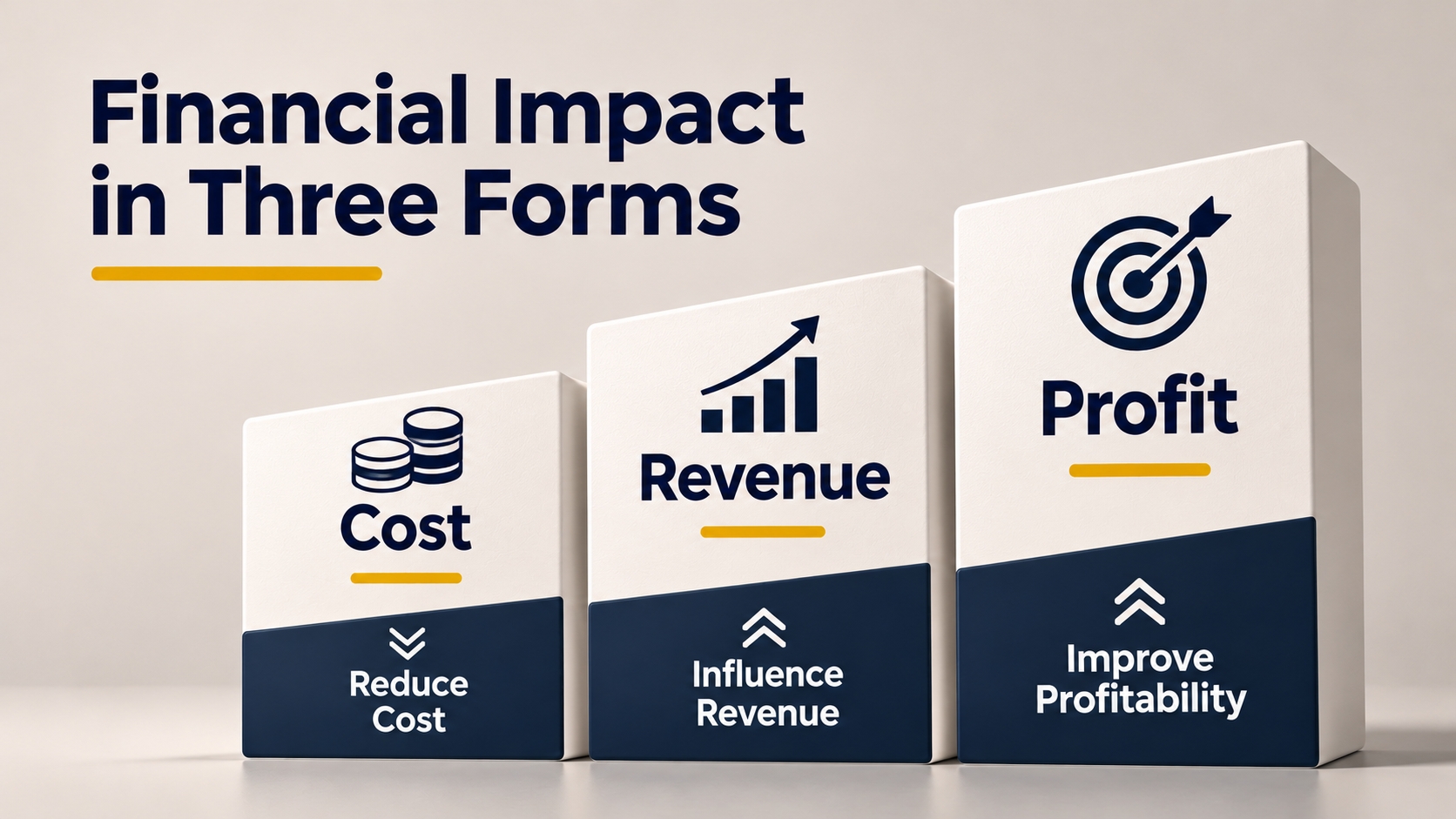
Every employer, whatever the industry, ultimately asks the same question about a finance hire: will this person make us more money, cost us less, or protect what we have? Cost savings, revenue influence and profit impact are the clearest answers you can put on a resume. They are also the most commonly mishandled, either left out entirely because "finance doesn't generate revenue," or stated so loosely that readers don't believe them.
This guide shows you how to identify, calculate and phrase financial impact so it's both compelling and credible, even if your role sits in a support function.
1. The Three Types of Financial Impact (and Why They Differ)
Not all financial impact is the same, and mixing them up is the fastest way to lose credibility.
| Type | What it means | Example |
| Cost savings | Actual reduction in spend versus a prior baseline | Renegotiated a vendor contract from $480K to $420K per year |
| Cost avoidance | Spend that would have occurred but was prevented | Redesigned a process that avoided hiring 2 additional FTEs |
| Revenue impact | Revenue you generated, protected or influenced | Pricing analysis that supported a 3% price increase on $60M of product |
| Profit/margin impact | Improvement in margin or earnings | Identified a $1.4M margin leak and corrected it within a quarter |
| Cash/working capital impact | Cash released or financing costs reduced | Cut DSO by 9 days, releasing about $3.9M of cash |
Label each one honestly. A "savings" claim that is really cost avoidance will be challenged in interviews.
2. Revenue: How to Claim It Without Overclaiming
Most finance roles don't own revenue, but they influence it. The key is choosing the right verb and being clear about your role:
- Generated: you directly produced the revenue (rare in finance, common in banking or sales-adjacent roles)
- Influenced / Supported: your analysis or model informed a decision that drove revenue
- Protected: you prevented revenue loss (churn analysis, credit risk, fraud prevention)
- Enabled: you built the process or model that made growth possible
Overclaimed: "Drove $20M in new revenue." Credible: "Built the pricing model that supported a 4% price increase across the $50M enterprise segment, contributing an estimated $2M in incremental annual revenue."
State the base, the mechanism and your role.
3. The Impact Formula: Baseline + Action + Result + Period
A strong financial-impact bullet has four parts:
- Baseline: what the number was before
- Action: what you specifically did
- Result: the change, in dollars and/or percentage
- Period: over what time frame (annual, one-time, within two quarters)
Example:
Reduced annual cloud infrastructure spend from $3.2M to $2.6M (19%) by renegotiating vendor contracts and rightsizing usage, delivering the savings within two quarters.
Without the baseline, a percentage means little. Without the period, readers can't tell whether the saving is recurring or one-time.
4. Where to Find Your Financial Impact
If you're not sure you have any, look at these areas:
Cost-related
- Vendor and contract renegotiations
- Process automation (hours saved × cost per hour)
- Headcount avoided through efficiency
- Reduced audit fees, bank fees, interest costs or penalties
- Eliminated duplicate tools, licenses or subscriptions
- Lower write-offs or bad debt
Revenue-related
- Pricing, discounting and promotion analysis
- Customer profitability and mix analysis
- Forecasts that enabled capacity or inventory decisions
- Billing accuracy and revenue leakage recovery
- Collections improvements that protected revenue
Profit and cash-related
- Margin improvement from product, customer or channel decisions
- Budget savings delivered against plan
- Working capital improvements (DSO, DPO, inventory turns)
- Capital allocation recommendations and returns
- Tax savings and structuring
5. How to Calculate Your Numbers
Here are practical methods when you don't have a ready-made figure.
Cost savings
(Old annual cost − new annual cost) Example: $480K − $420K = $60K annual savings.
Time-to-money conversion
Hours saved per cycle × cycles per year × loaded hourly cost Example: 6 hours × 52 weeks × $45 = about $14,000 per year.
Working capital release
Days improvement × average daily revenue (DSO) or daily COGS (DPO) Example: 9 days × ($160M ÷ 365) = about $3.9M.
Margin improvement
Revenue × margin percentage-point change Example: $40M × 1.5 points = about $600K in annual profit.
Revenue influence
Affected revenue base × percentage change Example: $50M × 4% = about $2M incremental revenue.
Always keep your calculation notes. In an interview, "here's how I got that number" is far more convincing than the number alone.
6. Annual, One-Time, and Cumulative: Be Explicit
Readers need to know whether a number repeats:
- Annual / run-rate: "saving $240K annually"
- One-time: "a one-time recovery of $400K"
- Cumulative: "$1.8M in savings over three years"
- Cumulative vs. annual confusion is a common credibility killer, so specify which one you mean.
7. Phrasing Examples by Finance Function
FP&A
- Before: "Prepared pricing and margin analysis."
- After: "Identified a $1.4M annual margin leak through customer-level profitability analysis, leading to a pricing correction that recovered the margin within one quarter."
Accounting / Controllership
- Before: "Managed vendor payments."
- After: "Captured $220K in annual early-payment discounts by restructuring the AP workflow and payment calendar."
Procurement-adjacent Finance
- Before: "Reviewed supplier contracts."
- After: "Renegotiated 12 supplier contracts totaling $18M in annual spend, delivering $1.3M (7%) in recurring savings."
Treasury
- Before: "Managed cash and liquidity."
- After: "Redeployed $8M of idle cash through improved visibility, reducing annual short-term borrowing costs by $110K."
Tax
- Before: "Handled tax filings."
- After: "Restructured intercompany arrangements to reduce the effective tax rate by 2.1 points, saving about $750K annually."
Credit and Collections
- Before: "Responsible for collections."
- After: "Reduced bad debt write-offs from 1.8% to 0.9% of revenue through tiered credit limits, protecting about $450K of annual profit."
Finance Leadership
- Before: "Led a cost reduction initiative."
- After: "Led a company-wide cost transformation delivering $35M (11%) in annual run-rate savings with no reduction in customer-facing headcount."
8. Credibility Guardrails
Financial claims face more scrutiny than any other part of a finance resume. Protect yourself:
- Don't take sole credit for team outcomes. Say "led," "co-led" or "contributed."
- Use ranges or "an estimated" when the figure is approximate. Honest estimates beat precise-looking guesses.
- Match the baseline. Savings against an inflated budget are not savings.
- Separate savings from avoidance. Label each clearly.
- Be ready to explain the math. Every number should survive a two-minute follow-up.
- Respect confidentiality. If exact figures are sensitive, use percentages or ranges ("a $500M+ revenue division," "approximately 12% of spend").
- Never invent or round up aggressively. One challenged number can undermine the entire resume.
9. Make the Business Meaning Visible
A number gains power when the reader sees why it mattered. End key bullets with the consequence:
- "...freeing $2M in budget to fund the company's expansion into two new markets."
- "...contributing to the company's first profitable quarter in three years."
- "...which funded a 15-person hiring plan without increasing the overall cost base."
This turns a finance metric into a business story.
10. Where to Place Financial Impact on Your Resume
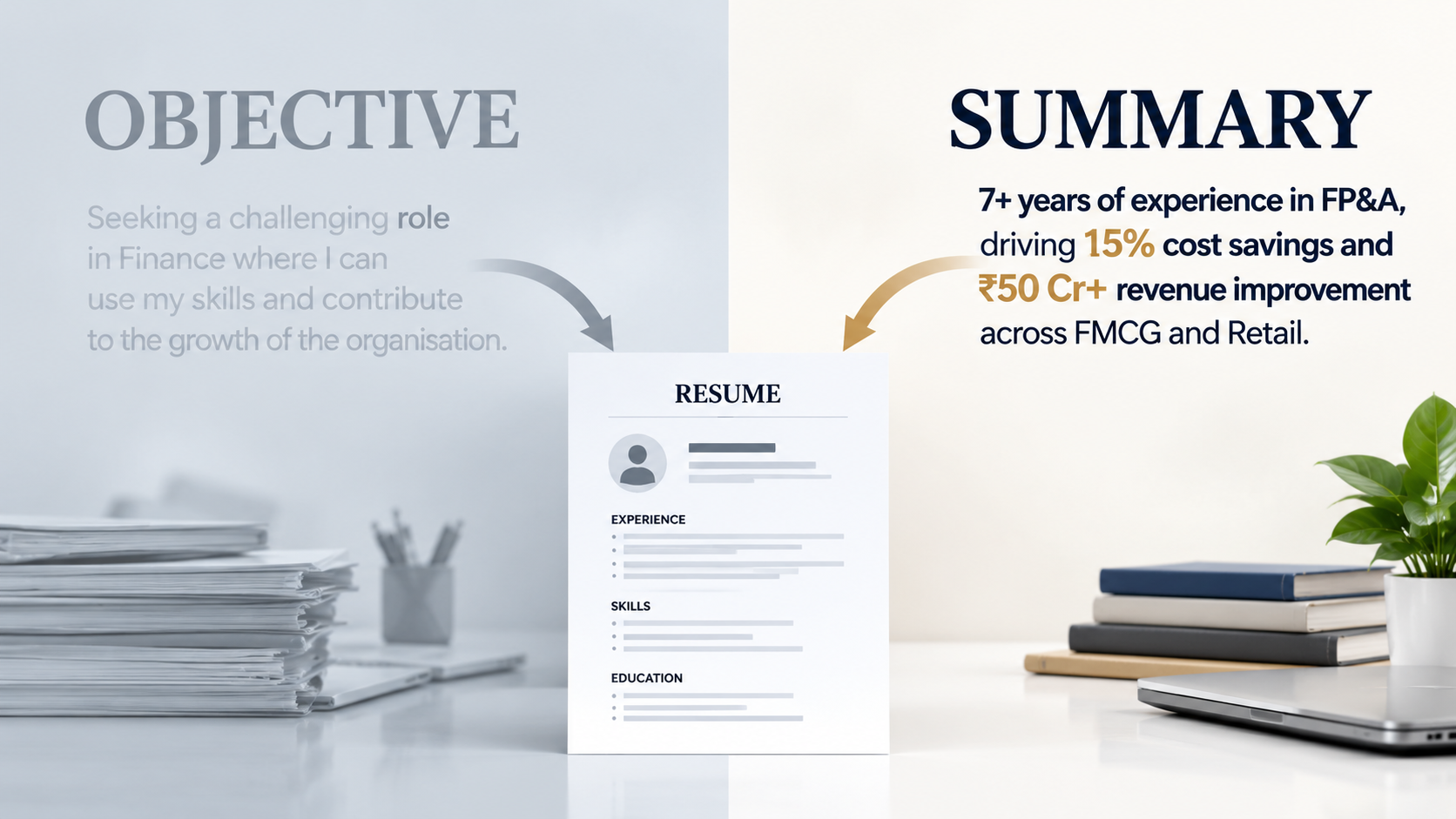
- Summary: include your single largest result (for example, "delivered $18M in working capital improvements").
- First bullet of each role: lead with the most significant financial outcome.
- Skills and credentials sections: keep these lean and put numbers in your bullets.
- Cover letter and LinkedIn: repeat the top two or three results consistently.
- Interview stories: prepare the full context behind each number.
Quick Self-Audit
- [ ] Does each financial claim state a baseline, action, result and period?
- [ ] Have I distinguished savings, cost avoidance, revenue influence and margin impact?
- [ ] Is it clear whether each figure is annual, one-time or cumulative?
- [ ] Is my role (led, co-led, contributed) honest and clear?
- [ ] Can I explain how every number was calculated?
- [ ] Have I connected the biggest results to a business outcome?
- [ ] Have I protected any confidential figures with percentages or ranges?