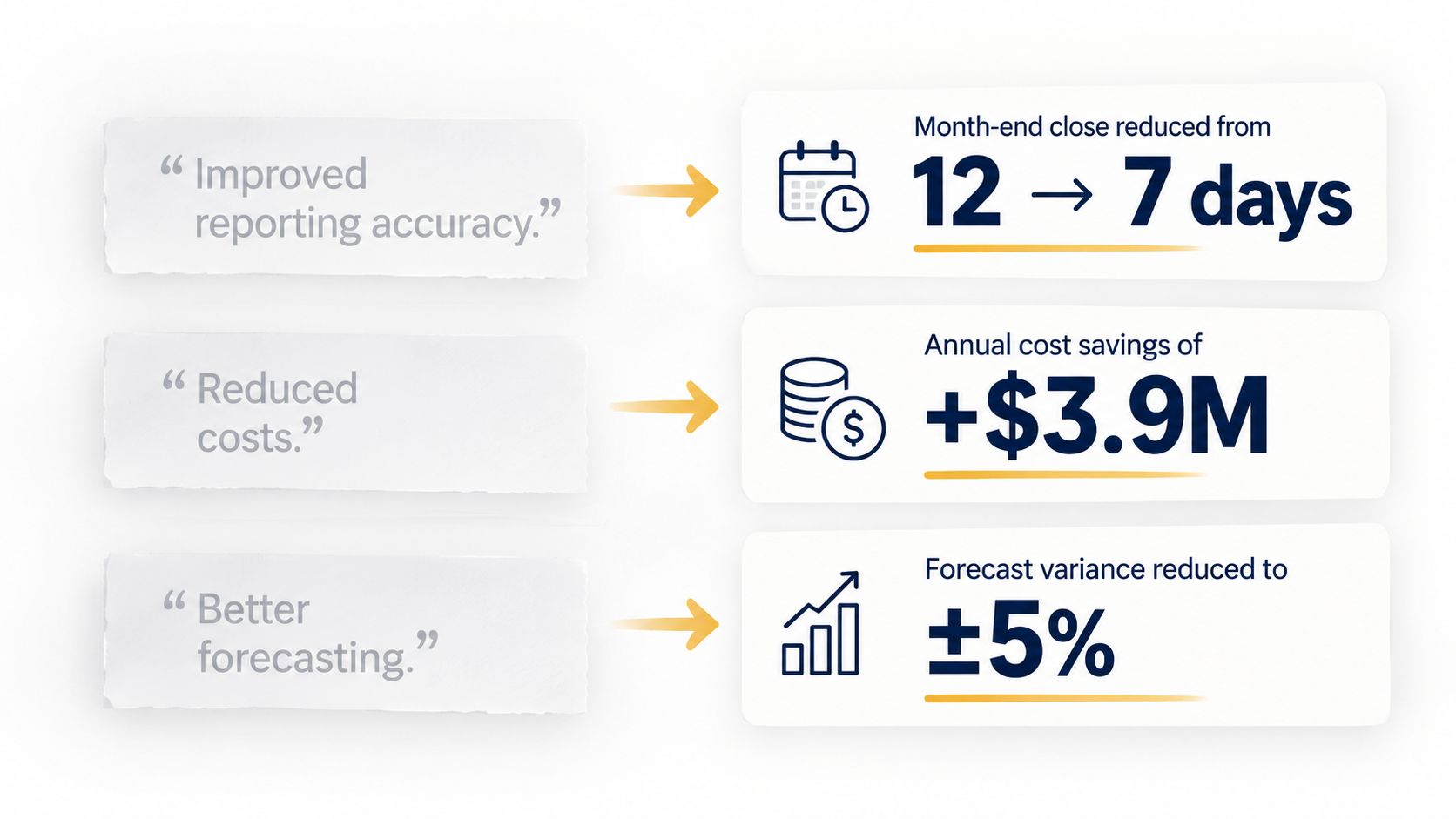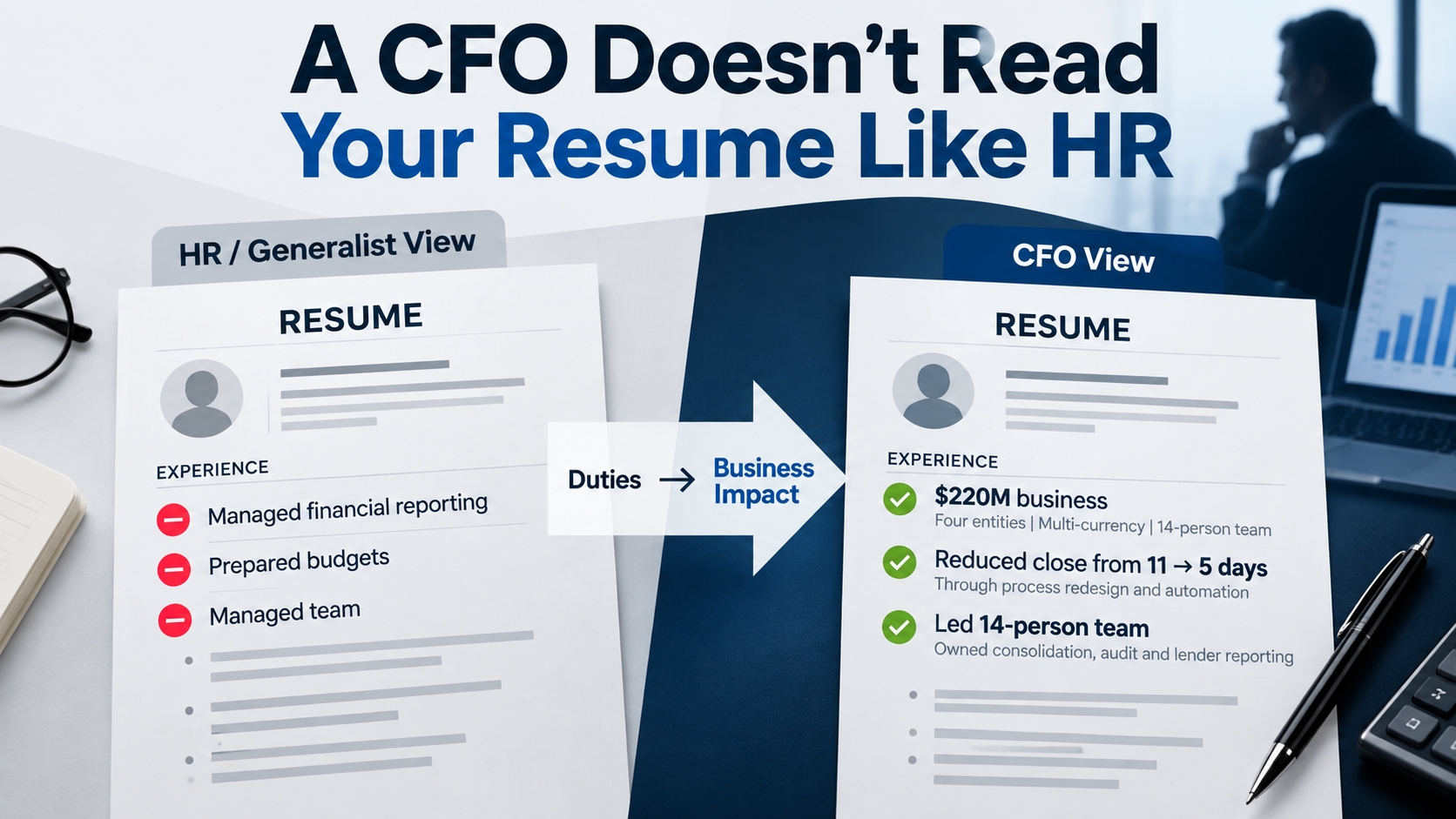
Open most finance resumes and you'll find the same thing: a list of duties. "Responsible for month-end close." "Managed budgeting and forecasting." "Prepared variance analysis for leadership." These lines describe a job. They don't describe a career.
The professionals who get promoted, headhunted, and trusted with bigger mandates do something different. They translate ordinary responsibilities into evidence: specific, quantified, business-relevant achievements that prove what changed because they were in the seat. This guide shows you how to make that translation, step by step.
1. Understand the Difference Between a Responsibility and an Achievement
A responsibility is what you were asked to do. An achievement is what happened because you did it.
Responsibility: "Managed the annual budgeting process."
Achievement: "Redesigned the annual budgeting process from a 10-week to a 6-week cycle, freeing 400+ hours of finance and business-unit time and giving leadership earlier visibility into hiring and capex decisions."
Anyone in your seat could claim the first line. Only you can claim the second.
2. Use the Before / Action / After Formula
For every responsibility, ask three questions:
- Before: What was the situation when I took this on? (A slow process, a risk, a gap, a cost, a complaint.)
- Action: What specifically did I change, build, decide, or lead?
- After: What measurably improved, and what did that make possible for the business?
Example:
- Before: Forecast accuracy was ±20%, and the sales team ignored the numbers.
- Action: Built a driver-based forecast with input from regional sales leads.
- After: Accuracy improved to ±6% within two quarters, and the forecast became the basis for hiring and inventory plans.
If you can't answer "Before," you're probably still describing a duty. Go back and find the problem it solved.
3. Mine Your Routine Work for Hidden Achievements
Most people think they have no achievements because nothing dramatic happened. Look instead at the recurring parts of your role and ask what you improved:
- Month-end close: Did you shorten it, reduce adjustments, or cut errors?
- Budgeting and forecasting: Did accuracy improve? Did you shorten the cycle or change how decisions were made?
- Reporting: Did you replace manual work with automation? Did you create a dashboard people actually use?
- Audit and compliance: Did you reduce findings, prep time, or external audit fees?
- Vendor and cost management: Did you renegotiate contracts or eliminate waste?
- Team management: Did you reduce attrition, promote someone, or speed up onboarding?
Routine work is where the most credible achievements live, because it's measurable over time.
4. Find the Number (Even When It Isn't Obvious)
Quantification is what makes an achievement credible. If you don't have an exact figure, build one:
- Time saved: hours per cycle × number of cycles per year
- Money saved or protected: cost avoided, savings realized, working capital released, or revenue enabled
- Scale: budget size, number of entities, transaction volume, headcount supported
- Accuracy or quality: error rate, forecast variance, audit findings before vs. after
- Speed: days or weeks removed from a process
When precise data isn't available, use a defensible estimate and label it honestly ("approximately," "an estimated"). A reasonable number beats no number, but never invent one you couldn't defend in an interview.
5. Connect Finance Metrics to Business Outcomes
A finance metric becomes career-defining when it's tied to something the business cares about: growth, risk, cash, or speed of decision-making.
| Finance Metric | Business Outcome It enabled |
| Close cut from 12 to 7 days | Leadership reacted to market shifts a week sooner |
| Forecast accuracy improved to ±6% | More confident hiring and inventory decisions |
| Clean audit with zero material findings | Supported a successful funding round or IPO readiness |
| DSO reduced by 9 days | Released $4M in working capital |
When you write an achievement, finish the sentence "...which meant that the business could ___."
6. Show Your Role Clearly: Led, Contributed, or Supported
Credibility depends on honest attribution. Reviewers can tell when someone claims a team's result as their own. Be precise:
- Led: you drove the initiative and owned the outcome.
- Co-led / Partnered: you shared ownership with a named function or person.
- Contributed: you played a defined role in someone else's initiative.
Even a contributing role can be powerful if you describe your specific piece clearly: "Built the financial model that underpinned the board's approval of the $30M expansion."
7. Elevate the Verbs
Verbs signal level. Task verbs describe activity; leadership verbs describe influence.
| Task Verbs (avoid) | Impact words (use) |
| Prepared, Handled, Assisted | Redesigned, Rebuilt, Launched |
| Responsible for, Worked on | Led, Drove, Owned |
| Helped with, Supported | Negotiated, Influenced, Transformed |
| Maintained, Updated | Streamlined, Consolidated, Scaled |
Pair a strong verb with a number and a business outcome, and a bullet transforms from a duty into a proof point.
8. Build an Achievement Bank, Not Just a Resume
Don't wait until you're job hunting to reconstruct your wins. Keep a running document where, each month, you log:
- What problem you solved or improved
- What you did
- The measurable result
- Who benefited, and any feedback received
This "brag file" becomes the raw material for your resume, LinkedIn profile, performance reviews, promotion cases, and interview stories. Memory fades quickly, and numbers are far easier to capture when they're fresh.
9. Pick Your Top Five and Tell Them as Stories
Not every achievement belongs on your resume. Select the three to five strongest, those that show scale, difficulty, business impact, or leadership, and prepare to tell each as a short story:
- Situation: What was the context and the problem?
- What you did: The specific decisions and actions you took
- Result: The numbers and business outcome
- Lesson: What you'd do differently or what it taught you
These become your signature stories across resume bullets, LinkedIn, performance conversations, and interviews.
10. Make Your Achievements Visible Before You Need Them
An achievement nobody knows about doesn't build a career. Share results proactively:
- Send a short summary of wins to your manager and key stakeholders after major milestones.
- Present outcomes in business terms in team and leadership meetings.
- Ask for specific endorsements or feedback from the people who benefited.
- Update your LinkedIn profile as results land, not years later.
Visibility turns achievements into reputation, and reputation is what drives promotions and opportunities.
Before-and-After Examples
Accounts Payable / Controllership
- Before: "Responsible for the accounts payable process."
- After: "Consolidated three AP processes into one shared workflow, cutting invoice processing time by 35% and capturing $220K in annual early-payment discounts."
FP&A
- Before: "Prepared monthly variance reports."
- After: "Introduced a driver-based variance review that surfaced a $1.4M margin leak in Q2, leading to a pricing correction that recovered the margin within one quarter."
Treasury
- Before: "Managed daily cash positioning."
- After: "Centralised cash visibility across 9 bank accounts, enabling $6M of idle cash to be redeployed and reducing short-term borrowing costs by $90K annually."
Finance Leadership
- Before: "Managed a team of 8 analysts."
- After: "Rebuilt an 8-person finance team after high turnover, reducing attrition from 35% to 10% and promoting two analysts into senior roles within 18 months."
Quick Self-Audit
- [ ] Does each bullet show a Before, an Action, and an After?
- [ ] Does most of your resume contain a number, a percentage, or a time frame?
- [ ] Have you connected finance results to a business outcome?
- [ ] Is your personal role (led, partnered, contributed) clear?
- [ ] Have you replaced task verbs with impact verbs?
- [ ] Do you keep a running log of wins you can pull from?
- [ ] Do you have three to five signature stories ready to tell?