The Business Impact
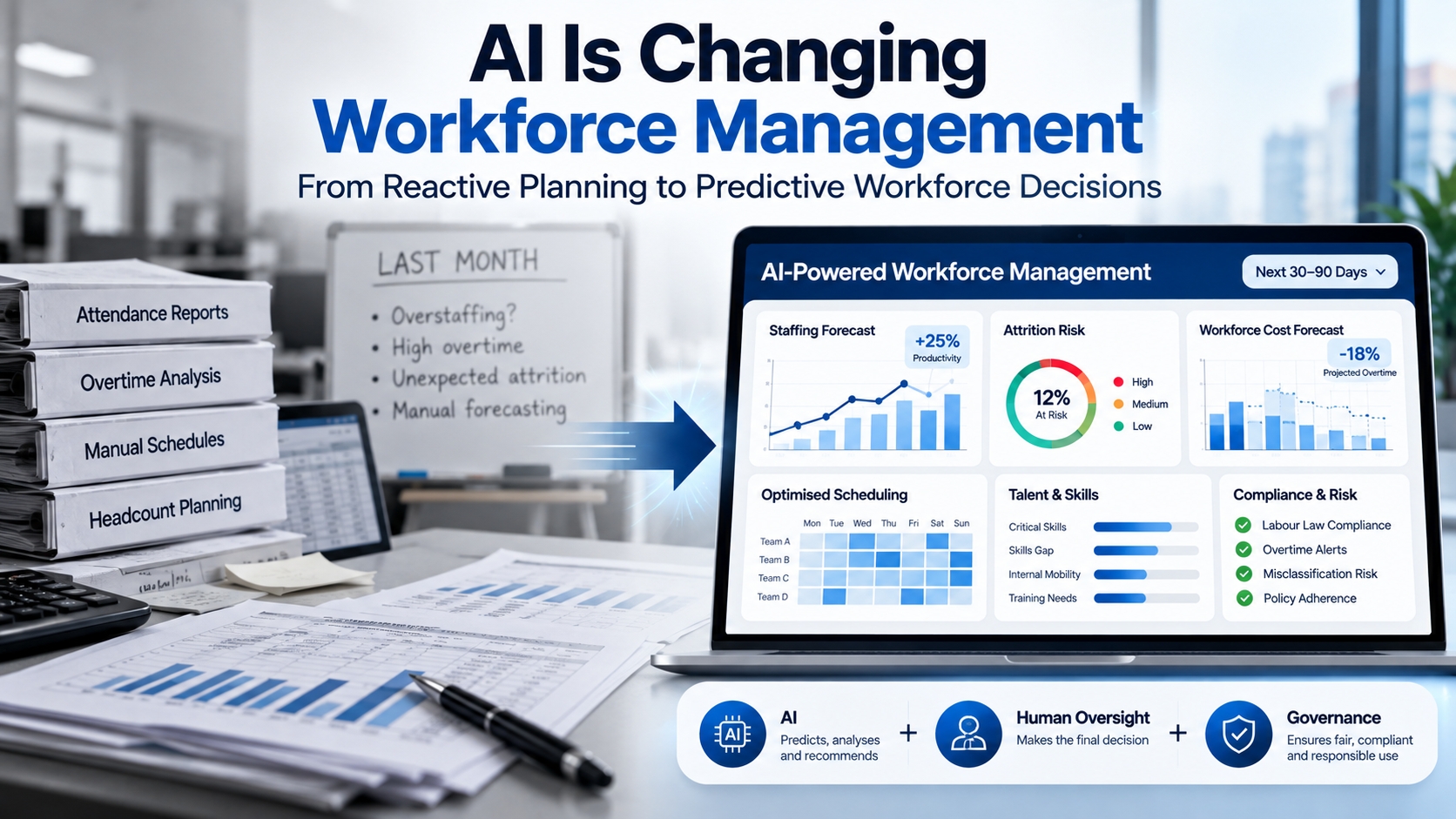
Workforce costs — salaries, overtime, temporary staffing, and turnover — are typically the largest controllable expense line for most companies. Traditional workforce management relies on lagging indicators: last month's overtime report, a spreadsheet forecast, a manager's gut instinct. AI changes the operating model from reactive to predictive.
Organizations that have deployed AI-driven workforce management tools report up to a 25% improvement in workforce productivity, along with meaningful reductions in overtime, overstaffing, and unplanned turnover costs, according to McKinsey Global Institute research. Separately, industry data shows generative AI copilots can cut schedule-creation time by up to 70%, while predictive labor analytics tools have been linked to a 15% improvement in staffing accuracy.
The Risks
The same technology that improves efficiency also introduces new categories of risk:
- Regulatory exposure — Employment AI tools used for hiring, scheduling, or performance decisions are increasingly regulated (more on this below).
- Bias and discrimination liability — Poorly audited algorithms can replicate or amplify hiring and scheduling bias.
- Change fatigue — Employees pushed into AI-driven tools without training disengage. Only 13% of workers have received any AI training so far, according to Randstad research cited in recent workplace-AI reporting.
- Vendor over-promising — Not every "AI-powered" workforce tool is built on real predictive models; some are static rules dressed up in AI marketing language.
The Opportunity
Done well, AI workforce management gives leaders a live, continuously updating view of labor demand, skills, cost, and risk — replacing annual planning cycles with real-time decisioning. It's also becoming a talent magnet: AI-related skills now appear in 2.5% of all U.S. job postings, a 297% increase over the past decade, per the Stanford HAI 2026 AI Index — meaning the ability to run AI-enabled workforce operations is itself becoming a competitive differentiator in the talent market.
What Is AI in Workforce Management?
In simple terms, AI in workforce management is the use of machine learning, predictive analytics, and automation to plan, staff, monitor, and support employees across their full lifecycle — from forecasting labor demand and building schedules, to predicting attrition risk, screening candidates, and flagging compliance issues.
Instead of a manager reviewing a static report once a month, AI systems continuously ingest data — attendance patterns, sales or service volume, seasonality, skills data, engagement signals — and generate recommendations or take automated action within guardrails a human sets.
In practical business terms: AI doesn't replace your HR or operations team. It replaces the manual, backward-looking parts of their job with forward-looking decision support, freeing people for judgment calls that still need a human.
How AI Is Transforming Core Workforce Functions
1. Demand Forecasting & Scheduling
AI models pull in historical attendance data, sales or transaction volume, seasonality, weather, and even local events to predict staffing needs — often days or weeks in advance. In healthcare settings, this kind of census-forecasting has been shown to achieve up to 95% accuracy in staffing needs 14 days out and cut temporary labor spend by half in documented deployments. In retail and hospitality, similar models are improving hourly labor forecasts by 15–20% compared to static, template-based scheduling.
2. Recruitment & Hiring
AI-driven applicant tracking, resume screening, and interview-analysis tools help recruiters manage volume — but this is also the most heavily regulated corner of AI workforce management (see the compliance section below). The safest and most defensible model in 2026 is "AI assists, humans decide": AI narrows and surfaces candidates; a person makes the actual selection.
3. Attrition Prediction & Retention
Predictive models flag flight-risk employees by analyzing engagement survey data, tenure patterns, manager-change frequency, compensation position relative to market, and workload signals — giving HR business partners a chance to intervene before a resignation letter lands.
4. Performance & Productivity Monitoring
AI tools increasingly track productivity signals and skills utilization, helping managers identify coaching needs or reallocate work — though this is also an area where employees are most sensitive to being "watched," making transparency essential.
5. Payroll, Compliance & Time Tracking
Machine learning models catch anomalies — duplicate punches, unusual overtime patterns, misclassification risk — before they become payroll errors or audit findings.
AI in Workforce Management: The Data at a Glance
| Metric | Data Point | Source |
| Large enterprises using AI in HR/workforce planning by 2026 | 80% (up from 30% in 2022) | Gartner |
| CHROs expecting greater AI integration in 2026 | 92% | SHRM 2026 CHRO Priorities Report |
| CHROs expecting increased AI adoption in HR processes | 87% (up from 83% in 2025) | SHRM |
| Productivity improvement from AI workforce management tools | Up to 25% | McKinsey Global Institute |
| Reduction in manual schedule-creation time (gen AI copilots) | Up to 70% | Mordor Intelligence |
| Improvement in staffing-forecast accuracy | ~15% | Technavio |
| AI-Powered Workforce Planning market size, 2026 | US $1.87 billion | Mordor Intelligence |
| Workers who've received formal AI training | 13% | Randstad |
| Global workforce needing reskilling by 2030 | 59% | World Economic Forum |
Key takeaway: Adoption is accelerating faster than training and governance — which is exactly where risk concentrates.
AI in Workforce Management Across Departments
AI workforce management isn't just an HR initiative — it touches how Finance plans headcount cost, how HR runs the employee lifecycle, and how Marketing and other functions compete for scarce, AI-literate talent.
For HR Leaders
HR owns the operational core: scheduling, attendance, performance, and retention. The priority is building AI fluency inside the HR team itself and establishing governance (audit trails, bias testing, human-in-the-loop review) before scaling any tool enterprise-wide.
For Finance Leaders
Labor is usually the single largest controllable cost center. AI-driven workforce forecasting turns headcount and overtime planning from a quarterly guess into a continuously updated model — directly improving budget accuracy, cost-to-serve calculations, and workforce ROI reporting.
For Marketing & Talent-Acquisition Leaders
Marketing teams are among the heaviest AI adopters functionally — 78% of marketing teams already use AI for content generation and customer segmentation — which also makes marketing one of the hardest functions to staff with genuinely AI-fluent talent. The same is true of AI-savvy recruiters who can evaluate AI hiring tools without introducing compliance risk. This is where a specialist search partner becomes valuable rather than optional.
The Compliance Landscape You Can't Ignore
This is the part most "AI in workforce management" articles skip — and it's the part that creates real legal exposure.
| Regulation | Scope | Key Requirement | Status in 2026 |
| NYC Local Law 144 | AI hiring/promotion tools evaluating NYC-resident candidates | Independent annual bias audit, public summary, 10 business days' candidate notice | In force since July 5, 2023; penalties $500–$1,500 per violation, per day |
| Colorado AI Act (SB 24-205) | High-risk AI systems, including employment | Algorithmic discrimination duties on developers and deployers | Effective February 1, 2026 |
| Illinois HB 3773 | Broader AI use in employment decisions | Extends bias-prevention duties beyond video interviews | Effective January 2026 |
| EU AI Act | AI used in recruitment, promotion, and termination decisions | Risk assessments, bias mitigation, human oversight, post-deployment monitoring | Classified as "high-risk"; obligations phase in through August 2026, with penalties up to €35 million or 7% of global turnover |
| U.S. federal (EEOC/Title VII) | Any AI tool affecting hiring decisions | Disparate-impact liability applies regardless of new AI-specific law | The EEOC has affirmed that AI tools fall within Title VII enforcement and that the four-fifths rule applies to algorithmic screening |
Practical takeaway: If a tool scores, ranks, or filters candidates or employees, assume you owe an audit trail, a disclosure, and a documented human-review step — regardless of which jurisdiction you're headquartered in. Multinational employers are increasingly aligning to whichever regime is strictest (usually the EU AI Act) rather than managing separate policies per country.
A Step-by-Step Framework for Adopting AI in Workforce Management
- Audit current workforce pain points. Identify where manual, reactive decisions are costing the most — scheduling, attrition, overtime, or hiring bottlenecks.
- Start with one high-friction, low-risk use case. Demand forecasting and scheduling are typically lower legal risk than AI-driven candidate scoring — a good place to prove value first.
- Establish human-in-the-loop governance up front. Define who reviews, overrides, and signs off on AI-generated decisions before deployment, not after.
- Vet vendors on transparency, not just claims. Ask what data feeds the model, how often it retrains, and whether it can produce an audit trail on demand.
- Run a bias/impact assessment before go-live, especially for any tool touching hiring, promotion, or termination decisions.
- Train the team using the tool — not just the team buying it. BCG research indicates a meaningful threshold: employees who receive at least five hours of AI training show significantly higher regular usage and confidence.
- Measure against business outcomes, not adoption metrics alone — overtime reduction, forecast accuracy, time-to-fill, and retention lift.
- Review and re-audit annually, and whenever the tool, vendor, or underlying model changes.
Best Practices Checklist
- ✅ Keep a human decision-maker in every hiring, promotion, or termination workflow
- ✅ Document data sources and retraining cadence for every AI tool in use
- ✅ Run independent bias audits for any AI tool used in candidate or employee scoring
- ✅ Give employees advance notice when AI tools are used in decisions affecting them
- ✅ Budget for training, not just software licensing
- ✅ Treat AI vendor contracts as compliance documents — clarify who owns audit responsibility
- ✅ Pilot before you scale enterprise-wide
Common Mistakes to Avoid
- ❌ Buying a workforce management tool because it's labeled "AI-powered" without asking what model, data, or logic sits behind it
- ❌ Rolling out AI scheduling or scoring tools without a documented bias audit
- ❌ Skipping employee training and expecting adoption anyway
- ❌ Treating compliance as a one-time checkbox instead of an annual requirement
- ❌ Letting AI make final hiring or termination decisions with no human review
- ❌ Ignoring the "silicon ceiling" — leadership using AI daily while frontline usage stalls, creating uneven adoption and hidden productivity gaps
Build, Buy, or Hire the Talent to Run It
Most organizations underestimate the third option. Buying a workforce management platform solves the software problem; it doesn't solve the skills problem. Someone still needs to interpret model outputs, manage vendor governance, and keep hiring practices compliant across jurisdictions — and that expertise is currently scarce and expensive to build internally.
This is increasingly where organizations lean on a specialist corporate recruitment and executive search partner: not just to fill a role, but to find people who already understand how to operate AI responsibly inside HR, finance, and marketing functions.
AI in workforce management has moved past the pilot-project stage. With 80% of large enterprises expected to have deployed some form of AI in HR and workforce planning by 2026, the question for most leaders isn't whether to adopt it — it's how to do so without outrunning governance, training, and compliance. The organizations winning with this technology are the ones treating it as a business discipline, not just a software purchase: a documented framework, human oversight built in from day one, and — critically — the right people to run it.
That last part is where most organizations get stuck. Great AI-workforce technology in the hands of a team that doesn't understand how to govern, interpret, or hire around it delivers a fraction of its value.
Get the Right People in Place
For HR Leaders: Rolling out AI workforce tools without an AI-literate HR operations lead is how compliance gaps happen. Talk to our search team about sourcing HR technology and people-analytics leaders who already know how to govern AI responsibly.