India’s labour law reforms are becoming one of the biggest compliance discussions for employers in 2026.
With the government operationalizing labour-code provisions and notifying final central rules in 2026, businesses across sectors are reassessing payroll structures, salary breakups, statutory calculations, and HR compliance practices.
For HR teams, payroll professionals, finance departments, startups, staffing firms, and growing companies, the Code on Wages is no longer just a future reform discussion. It is increasingly becoming an operational reality.
Note: Labour-code implementation and enforcement may vary depending on state-level rules, establishment category, and jurisdiction.
What Is the Code on Wages?
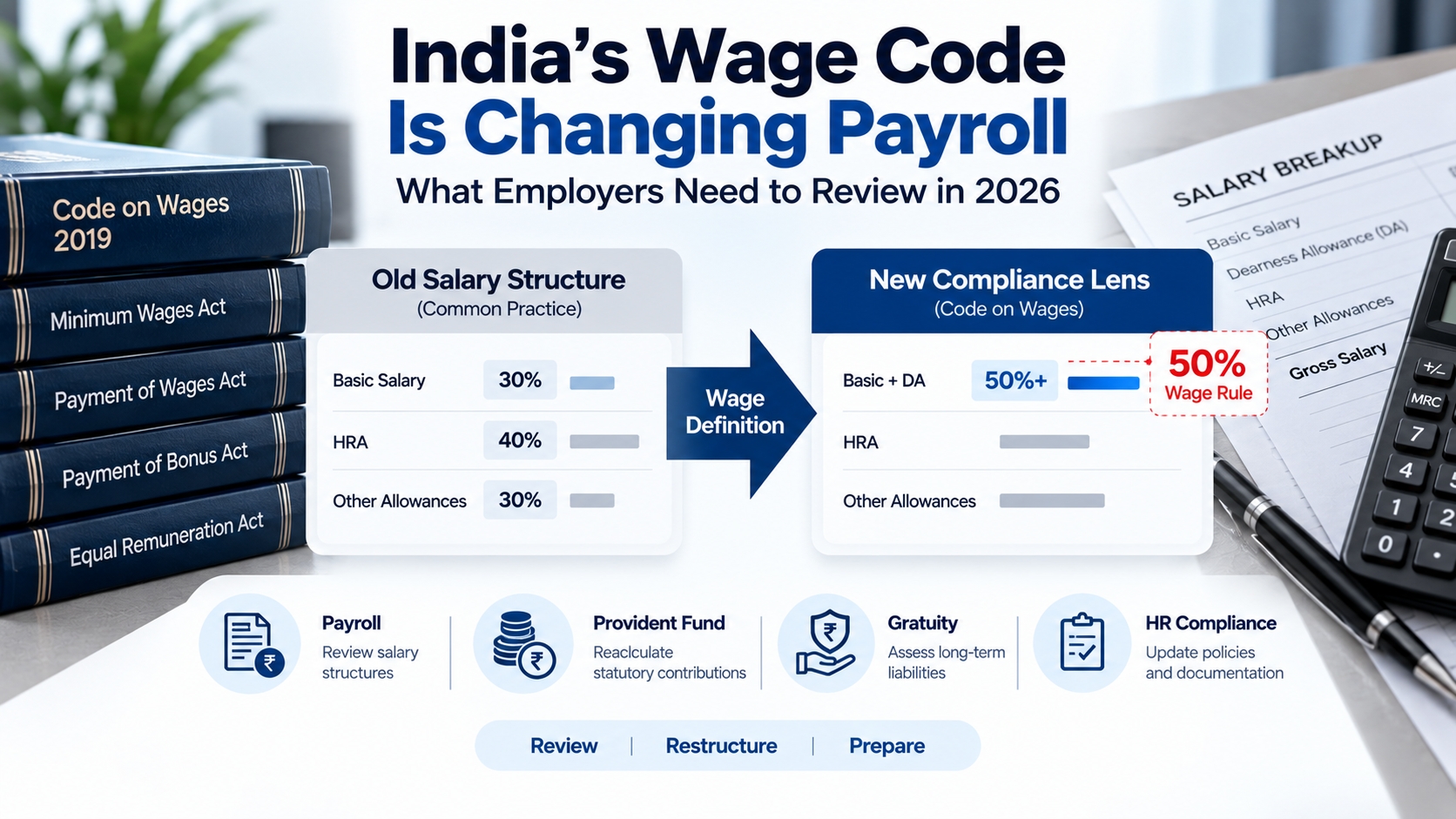
The Code on Wages, 2019 was introduced to simplify and consolidate India’s wage-related labour laws under a single framework.
It replaces four major labour laws:
- Minimum Wages Act, 1948
- Payment of Wages Act, 1936
- Payment of Bonus Act, 1965
- Equal Remuneration Act, 1976
The objective is to create greater transparency and consistency in wage-related compliance across industries.
What Changed in 2026?
2026 is being viewed as a transition phase for labour-code compliance in India.
Recent developments include:
- Final central rules notified
- Increased focus on payroll restructuring
- Greater scrutiny on PF and gratuity calculations
- Discussions around contractor compliance and wage definitions
- Rising HR and payroll audit preparedness
While the central framework is operational, implementation may still vary across states and establishment types.
Understanding the New Definition of “Wages”
One of the most important changes under the Code on Wages is the revised definition of “wages.”
Core wage components generally include:
- Basic salary
- Dearness allowance (DA)
- Retaining allowance
Certain components are broadly excluded, such as:
- HRA
- Bonus
- Overtime
- Commission
- Incentives
- Employer PF contribution
However, exclusions cannot exceed prescribed limits under the wage-code framework.
This directly impacts:
- Provident Fund (PF)
- Gratuity
- Bonus calculations
- Overtime calculations
- Payroll structuring
What Is the 50% Wage Rule?
Under the Code on Wages framework, wages such as basic pay and DA should generally constitute at least 50% of total remuneration, with excess allowances potentially added back for statutory calculations.
This is one of the most discussed aspects of the labour codes because of its direct impact on payroll costs and salary structuring.
Why Employers Are Paying Attention
Earlier, many organizations used higher allowances and lower basic salaries to reduce statutory liabilities.
The revised framework limits aggressive salary structuring practices and may increase:
- PF contributions
- Gratuity liabilities
- Long-term payroll obligations
As a result, many companies are reviewing compensation structures to align with compliance expectations.
Impact on Employees
For employees, the impact may vary depending on salary structure.
Potential long-term benefits include:
- Higher PF accumulation
- Better gratuity benefits
- Improved retirement savings
- Greater wage transparency
However, in some cases, employees may notice slightly lower take-home salary because of increased statutory deductions.
Key Challenges for HR and Payroll Teams
The labour-code transition is creating operational challenges for employers, especially those operating across multiple states.
Common focus areas include:
- Payroll restructuring
- HRMS and payroll software updates
- Revising employment contracts
- Documentation readiness
- Contractor compliance reviews
- Statutory recalculations
Businesses may also need stronger digital documentation and audit-readiness processes.
Why Startups and SMEs Should Care
Labour compliance is increasingly becoming part of operational maturity for startups and SMEs.
Investors, auditors, and enterprise clients are paying closer attention to:
- Structured payroll systems
- Employment documentation
- Contractor classification
- Compliance preparedness
As businesses scale, weak payroll or labour compliance practices can create operational and financial risks.
What Businesses Should Do in 2026
Employers should consider taking proactive steps such as:
- Auditing compensation structures
- Reviewing PF and gratuity calculations
- Checking alignment with the 50% wage framework
- Updating payroll systems
- Reviewing contractor agreements
- Training HR and payroll teams
- Monitoring state-level labour notifications
Final Thoughts
India’s Code on Wages is becoming a major compliance and payroll transition topic in 2026.
The changes are pushing businesses to rethink salary structures, statutory calculations, HR documentation, and payroll governance practices.
While implementation may continue evolving across states and sectors, organizations that prepare early may manage the transition more smoothly than those reacting later under compliance pressure.