Consider a company facing a CFO transition. The incumbent has resigned, with a 90-day notice period remaining. The board wants a successor in place before the next fundraise.
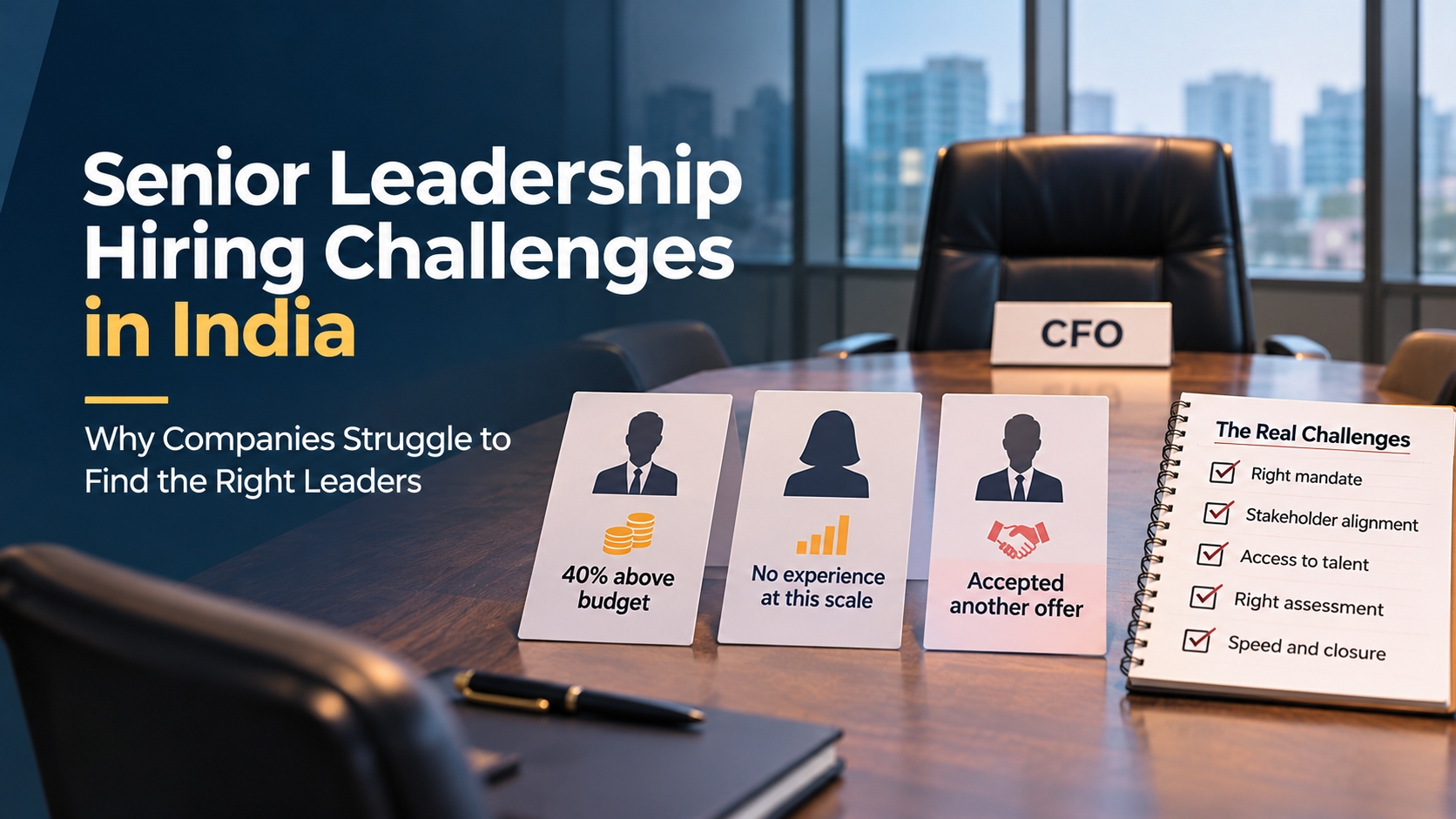
Six weeks later, the company has a shortlist of three candidates. One expects 40% more than the approved budget, another has never worked in a business of this size, and the third has quietly accepted another offer.
This is a situation many founders, CEOs and CHROs can relate to.
Senior leadership hiring is one of the most consequential recruitment decisions a company makes. Yet, organisations continue to face challenges in identifying, attracting and retaining the right leaders.
The candidate market is part of the problem. The bigger challenge often lies in how companies define, search for, assess and close senior leadership positions.
This article explores the major senior leadership hiring challenges Indian companies face, why these challenges persist, and what organisations can do differently to build stronger leadership teams.
The Numbers Behind the Problem
Recent research highlights the scale of India's talent and leadership pipeline challenges.
- Talent shortages remain significant: According to ManpowerGroup's 2026 Global Talent Shortage Survey, 82% of Indian employers reported difficulty finding the skilled talent they need. In the finance and insurance sector, the figure stood at 85%.
- Internal succession remains a challenge: CIEL HR's State of Leadership in India 2026 mapped approximately 630,000 senior leaders. The study found that 82.6% of India's C-suite positions were filled through external hiring. India also has approximately two VPs for every chief role, compared with three to five in most large markets.
- Senior leaders are open to new opportunities: Page Executive India's Executive Compensation & Talent Trends Report 2026 surveyed more than 1,200 senior leaders. It found that 94% were open to new opportunities, 63% were actively looking for a new role, and 41% did not expect to remain in their current position for more than a year.
- Leadership talent is concentrated in major cities: CIEL HR's study found that six metros accounted for approximately 66.7% of India's senior leadership talent and 94% of its CXO titles.
Together, these findings highlight three important challenges: competition for skilled talent, limited internal succession pipelines and the geographical concentration of senior leadership talent.
For companies, this means that finding someone with the right experience, leadership capabilities, industry exposure and business understanding requires a more deliberate approach.
Why Companies Struggle to Hire the Right Senior Leaders
1. The Role Is Defined by Its Last Occupant, Not by the Next Three Years
Many senior leadership searches begin with the previous incumbent's job description.
However, that document describes what the previous leader was responsible for. It may not reflect what the business needs from its next leader.
A company preparing for a fundraise, IPO, international expansion, business turnaround or ERP transformation may require an entirely different leadership profile.
Consider two companies hiring a CFO.
One needs a strong financial controller who can strengthen reporting, compliance and financial discipline. The other needs a strategic finance leader who can manage investor relationships, fundraising and capital allocation.
Both positions carry the same title, but their expectations are very different.
Without clearly defining the business mandate, companies risk attracting candidates who look suitable on paper but lack the capabilities required for the next stage of growth.
2. Too Many Stakeholders, Too Little Alignment
Senior leadership hiring often involves multiple decision-makers.
The CEO may prioritise business growth, the board may focus on governance, investors may look for financial discipline, and the CHRO may emphasise leadership style and cultural fit.
These expectations are not necessarily contradictory. However, when stakeholders fail to align before the search begins, the recruitment process becomes complicated.
Candidates may face repeated interviews, changing expectations and conflicting feedback.
Strong candidates notice these inconsistencies and may eventually lose interest.
The solution is to establish clear hiring criteria, decision-making authority and stakeholder responsibilities before approaching the market.
3. The Best Candidates Aren't Applying
Traditional job postings and inbound applications may not reach the strongest senior leadership talent.
Many experienced executives are already employed, performing well and not actively searching for another opportunity.
Even though Page Executive's 2026 research found that 94% of surveyed senior leaders were open to new opportunities, being open to a career move does not necessarily mean actively applying for jobs.
This is where executive search becomes important.
Companies need to identify relevant professionals, understand their career motivations and approach them with a compelling business opportunity.
A successful approach requires more than sharing a job description. It requires understanding what could motivate an experienced leader to consider a change.
4. Pedigree Is Mistaken for Capability
A well-known company name on a CV can create a strong first impression.
However, working with a reputed organisation does not automatically establish that someone can lead a different business environment successfully.
A finance leader from a large multinational may have worked with established systems, large teams and clearly defined processes.
Moving into a 300-person founder-led business may require a very different approach, including hands-on execution, resource management and the ability to build processes from scratch.
Companies should evaluate what candidates have actually delivered, the business environment in which they delivered it, and how they handled difficult decisions.
The focus should be on demonstrated capabilities rather than employer brands alone.
5. The Search Is Too Narrow
Restricting a leadership search to candidates who have worked in the same industry, held the exact same designation and lived in the same city can unnecessarily limit the talent pool.
CIEL HR's study identified approximately 76,000 senior leaders across eight tier-2 cities, including around 1,800 CXO-level roles.
This highlights the importance of looking beyond the traditional metropolitan talent markets.
For example, a CFO from an adjacent industry may bring relevant experience in working capital management, financial controls, business partnering or fundraising.
Similarly, a senior finance leader from a tier-2 city may be willing to relocate for the right leadership opportunity.
Expanding the search does not mean compromising on quality. It means evaluating transferable capabilities and relevant business experience more intelligently.
6. The Recruitment Process Moves Too Slowly
Senior leadership candidates often evaluate multiple career opportunities simultaneously.
A prolonged hiring process can put companies at a disadvantage.
Long gaps between interview rounds, unclear feedback, repeated discussions with different stakeholders and delayed approvals can create uncertainty.
Candidates may interpret these delays as signs of indecisiveness within the organisation.
A structured hiring process should have predefined interview stages, clear timelines, prompt feedback and an accountable decision-maker.
Speed matters, but it should not come at the expense of a thorough assessment.
7. The Offer Conversation Starts Too Late
Compensation is an important consideration in senior leadership hiring.
Page Executive's 2026 survey found that 87% of respondents identified pay as a key driver of job satisfaction.
However, compensation is not the only factor influencing an executive's decision.
Reporting structure, decision-making authority, long-term incentives, ESOPs, relocation requirements, professional growth and family considerations can also influence whether a candidate accepts an offer.
When these discussions happen only at the final stage, companies risk losing candidates after investing considerable time in the recruitment process.
Organisations should discuss compensation expectations, role scope, reporting lines and other important considerations early in the hiring journey.
What It Costs to Get Senior Leadership Hiring Wrong
A wrong senior leadership appointment can affect much more than recruitment costs.
The consequences can extend across business performance, organisational stability and long-term growth.
1. Time and Leadership Bandwidth
A failed appointment means restarting the search, conducting additional interviews and spending more time from senior management and board members.
2. Delayed Business Strategy
Important business decisions involving fundraising, expansion, financial restructuring or transformation may get delayed when the leadership position remains vacant or is occupied by the wrong person.
3. Team Disruption
A senior leader influences the people reporting to them. A wrong appointment can create uncertainty, affect team morale and increase employee turnover.
4. Employer Reputation
Repeated leadership changes can raise questions among employees, candidates, investors and business partners about the organisation's decision-making and stability.
The impact of a wrong leadership appointment often extends beyond the individual position.
We will explore this subject in greater detail in our upcoming article, The Hidden Cost of a Wrong Leadership Hire.
What Better Leadership Hiring Looks Like
Companies that approach senior leadership recruitment strategically tend to follow a few important practices.
1. Start With a Business Mandate, Not a Job Description
Before initiating a search, organisations should establish three things:
- Expected business outcomes: What should the new leader accomplish in the first 12–24 months? Examples include completing a fundraise, improving working capital, strengthening financial controls or building a new team.
- Essential capabilities: Which qualifications, experiences and leadership skills are non-negotiable? Where can the company remain flexible?
- Decision-making authority: Who has the final hiring authority, and what role will other stakeholders play in the process?
A clearly defined mandate helps recruiters identify candidates who match the actual business requirements rather than simply matching a list of keywords.
2. Map the Market Before Shortlisting
A proper executive search should begin with understanding the available talent market.
Companies should evaluate:
- Relevant organisations and potential talent pools.
- Compensation benchmarks and candidate expectations.
- Professionals working in adjacent industries.
- Candidates who may be open to relocation.
- The experience and capabilities available within the approved budget.
Market mapping also helps identify whether the ideal candidate profile is realistic at the proposed compensation level.
It is better to understand these limitations early than to discover them after several weeks of searching.
3. Assess Candidates for Context, Not Just Credentials
Qualifications and professional experience are important, but they do not provide a complete picture of leadership capability.
Companies should use structured interviews, business scenarios, competency-based assessments and thorough reference checks.
For example, when hiring a CFO, organisations can evaluate how the candidate has handled:
- Cash flow challenges and working capital management.
- Fundraising, investor relationships and financial strategy.
- Financial controls, reporting and regulatory compliance.
- Team building and leadership development.
- Business transformation and strategic decision-making.
The objective is not simply to determine whether someone is a good leader.
It is to understand whether they are the right leader for the organisation's current business stage and future priorities.
4. Run a Structured and Respectful Hiring Process
A well-managed recruitment process improves both candidate experience and hiring outcomes.
Companies should establish interview timelines in advance, communicate expectations clearly, provide timely feedback and assign one person to manage candidate communication.
Every interview should have a defined purpose.
This prevents repetitive discussions and helps decision-makers evaluate candidates against consistent criteria.
5. Close Early and Close Properly
Organisations should not wait until the final interview to discuss compensation, role expectations and other important considerations.
A better approach includes:
- Understanding compensation expectations during the initial conversations.
- Clarifying the reporting structure and decision-making authority.
- Discussing long-term incentives and ESOP structures, where applicable.
- Addressing relocation and personal considerations early.
- Aligning all stakeholders before extending the offer.
The hiring process should also include a structured onboarding plan to help the new leader understand the organisation, build relationships and establish priorities.
The first 90 days can significantly influence a senior leader's integration and effectiveness.
6. Build the Leadership Pipeline Before a Vacancy Arises
One of the biggest mistakes organisations make is starting succession planning only after a senior leader resigns.
CIEL HR's research highlights an interesting difference between Global Capability Centres (GCCs) and Indian enterprises.
GCCs in India have approximately eight VPs per chief role, compared with around two nationally. They also promote internally 43% of the time, compared with 22% at Indian enterprises.
This highlights the importance of developing internal leadership capabilities.
Companies should identify high-potential employees, create leadership development opportunities, establish succession plans and maintain relationships with external talent.
A stronger leadership pipeline reduces dependence on urgent external hiring and gives organisations more flexibility when senior positions become vacant.
A Quick Self-Check for Your Next Senior Leadership Hire
If three or more of the following statements apply to your organisation, your leadership search may need a more structured approach.
- The job description was copied from the previous incumbent.
- Stakeholders haven't agreed in writing on the essential hiring criteria.
- Most candidates so far have come from job postings or inbound applications.
- The search is restricted to one city and one industry.
- Interview rounds are more than a week apart.
- Compensation flexibility hasn't been discussed internally.
- No potential internal successors have been identified or developed for the role.
The more of these challenges an organisation faces, the greater the need to revisit its hiring strategy before proceeding further.
How Corenza Can Help
Finding the right senior leader requires more than identifying someone with the right designation and years of experience.
It requires understanding the business, defining the leadership mandate, mapping the relevant talent market and assessing candidates against the organisation's current and future requirements.
At Corenza, we work with businesses across India on senior and leadership hiring, with a particular focus on finance leadership.
Our approach focuses on:
- Role Definition: Understanding business priorities and translating them into a clear leadership mandate.
- Market Mapping: Identifying relevant talent pools across industries, organisations and locations.
- Executive Search: Reaching experienced professionals who may not be actively applying for opportunities.
- Candidate Assessment: Evaluating professional expertise, leadership capabilities and business suitability.
- Hiring Support: Helping organisations manage candidate engagement and the offer process.
Whether you are hiring a CFO, Finance Controller, FP&A Head, Head of Treasury or another senior finance professional, the objective remains the same: finding the right leader for your business.
Planning a senior leadership hire?
Connect with Corenza to understand how a structured executive search approach can help your organisation identify and attract the right leadership talent.