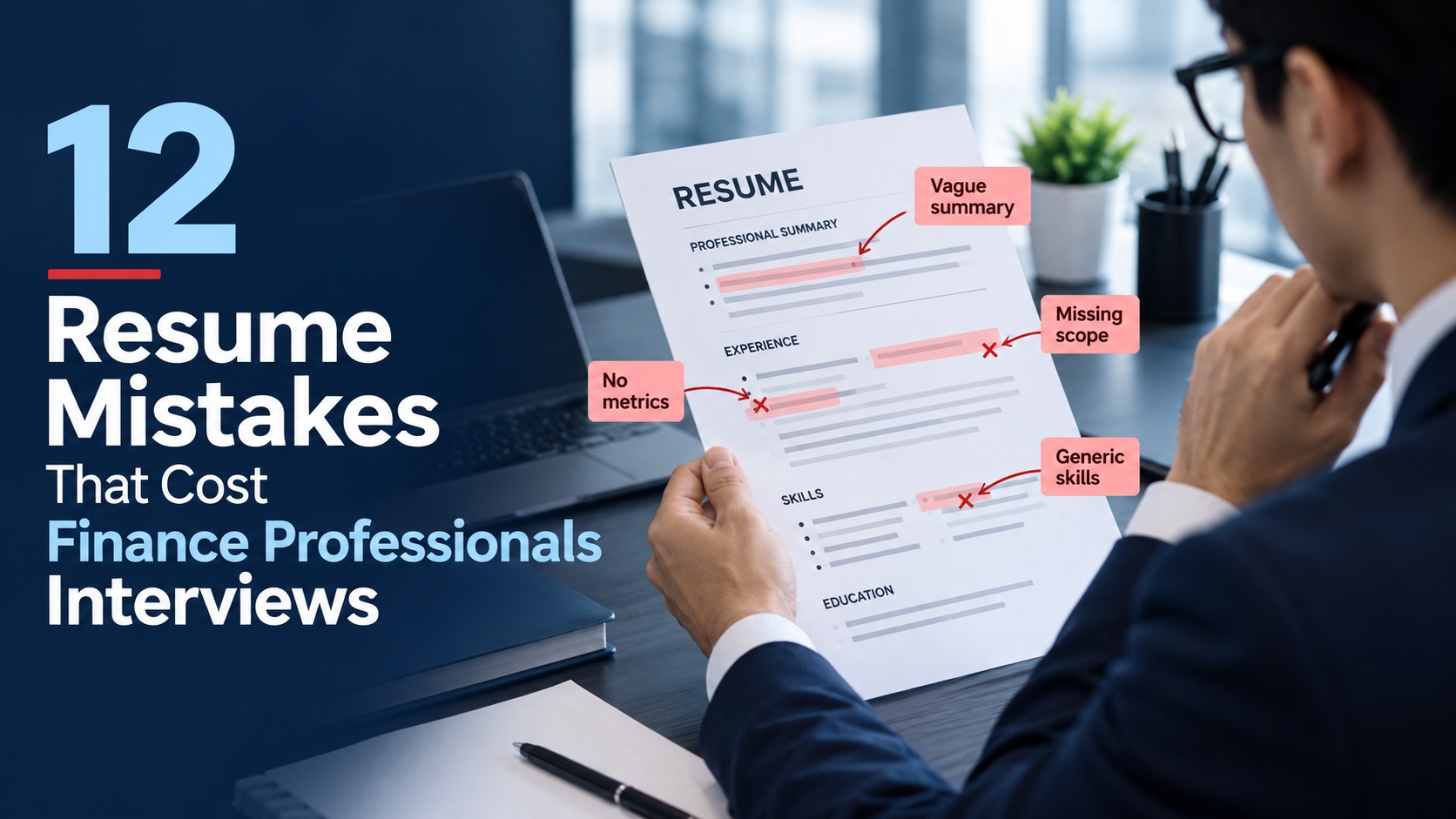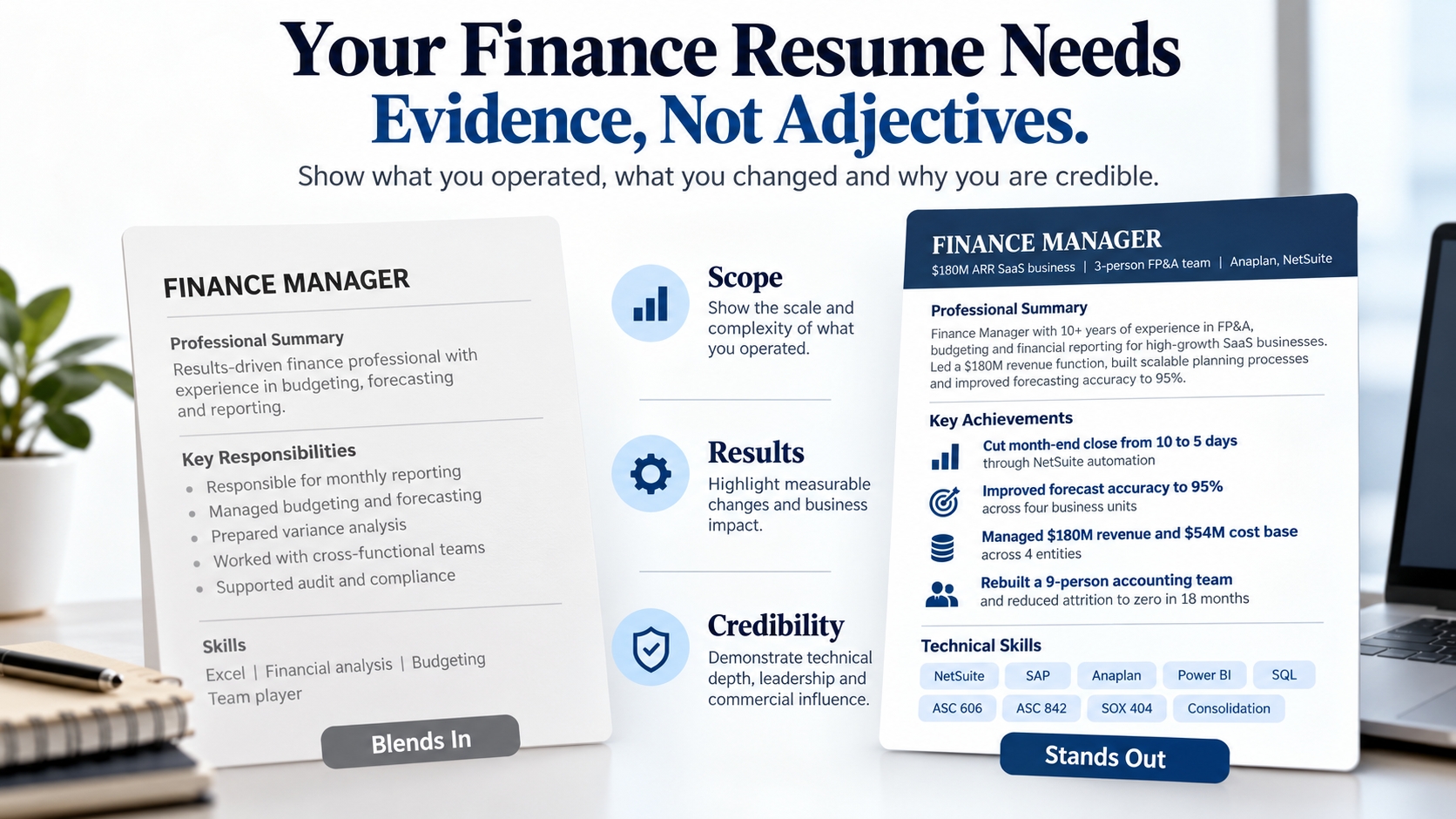
Most finance resumes look alike. The same titles, the same duties, the same phrases: "detail-oriented," "proven track record," "responsible for month-end close." A recruiter reviewing forty of them for one Controller or FP&A Director search is not looking for the best-written resume. They are looking for the fastest evidence that you have already done this job, at this scale, with results.
Standing out in finance rarely means better design or cleverer wording. It means making three things obvious quickly: what you operated, what you changed, and why you are credible. This guide shows ten ways to do that, with before-and-after examples for mid-to-senior finance professionals.
What "Standing Out" Actually Means in Finance
Finance recruiters and hiring CFOs screen for risk and return. They want to know whether you can be trusted with the numbers and whether you will improve the function. A resume stands out when it answers both questions in the first few lines, without making the reader dig.
That also changes how you should think about competition. You are not competing with people who are less qualified. You are competing with equally qualified people who explain themselves better.
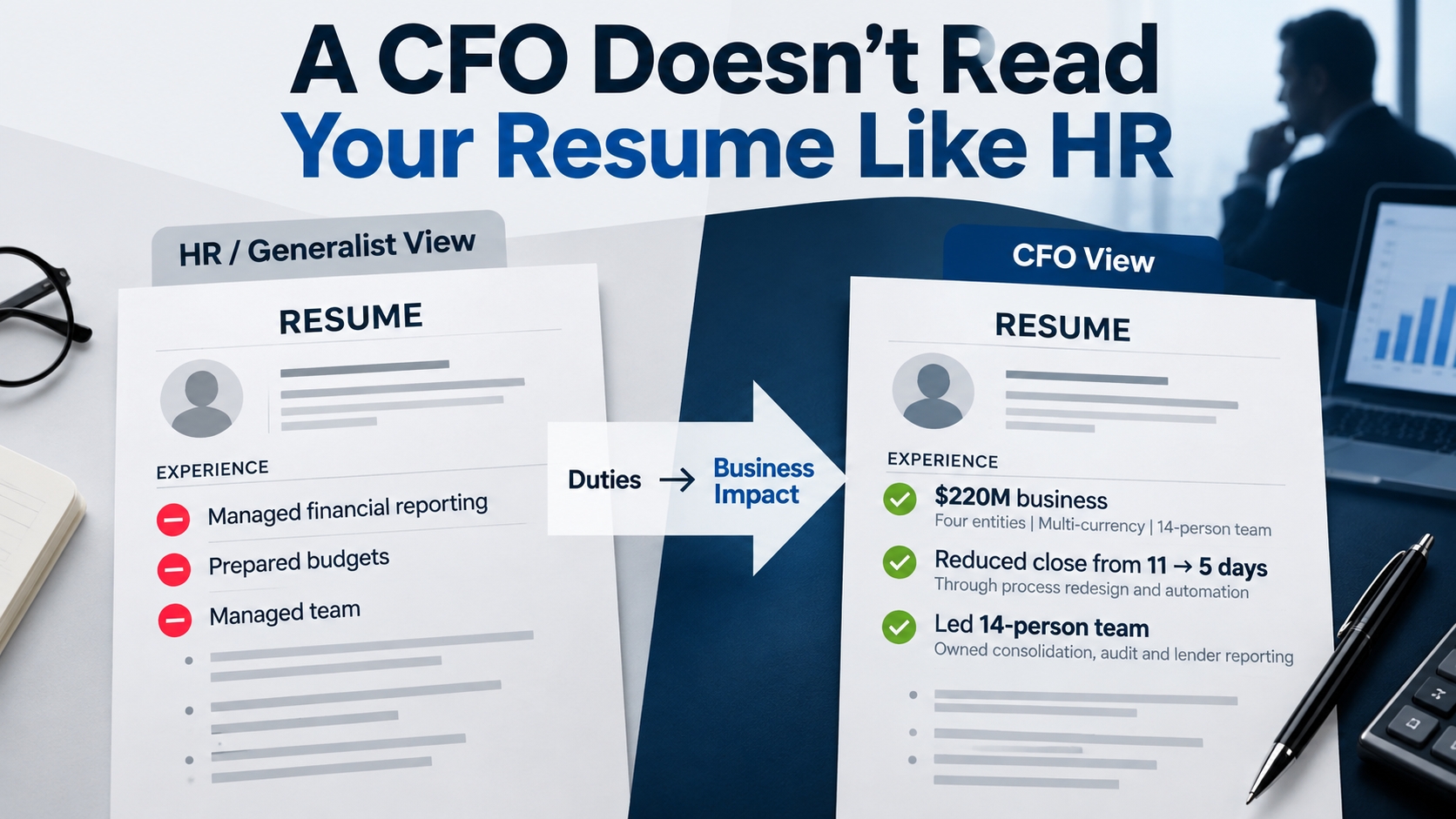
1. Lead With Scope, Not Just Your Title
Two people can hold the same title and run very different jobs. Make the size and complexity of your remit impossible to miss.
Blends in: "Finance Manager, XYZ Technologies." Stands out: "Finance Manager, XYZ Technologies ($180M ARR SaaS business; owned revenue and headcount planning; 3-person FP&A team; Anaplan, NetSuite)."
State revenue or budget owned, entity count, team size, and key systems in the first line or two of each recent role. If figures are confidential, use ranges ("$150–250M revenue").
2. Replace Duties With Outcomes
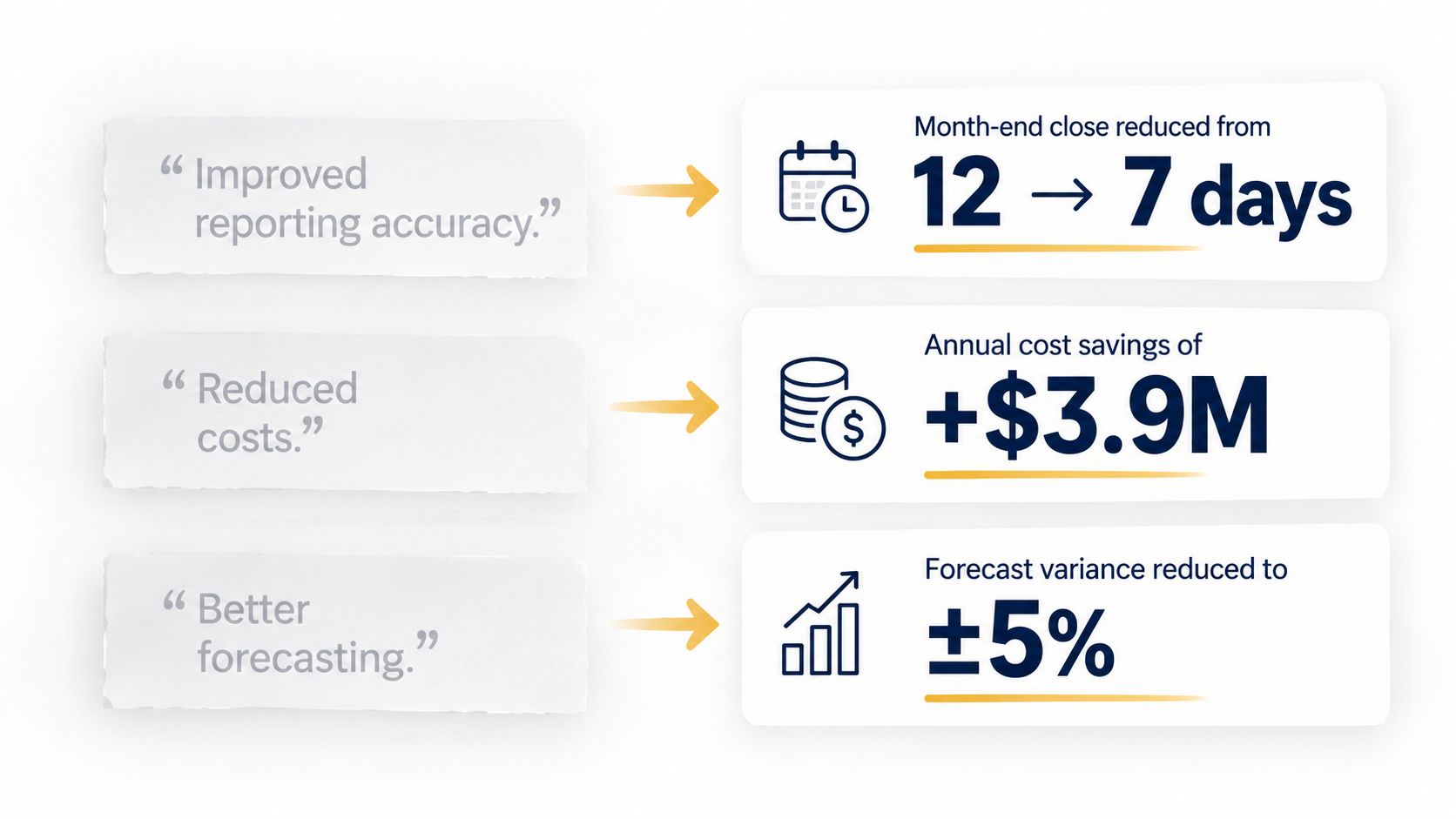
A duty tells the reader what your job description said. An outcome tells them what happened because you held the seat. Use the pattern action + process or system + measurable result.
Blends in: "Responsible for monthly variance analysis." Stands out: "Built monthly variance analysis on a $54M cost base, cutting budget-to-actual variance from 9% to under 3%."
If a bullet could appear unchanged on a colleague's resume, it is still a duty.
3. Put Numbers on Everything You Reasonably Can
Finance is a numbers function, so numbers are the expected language. Use dollars, percentages, days, headcount, basis points, deal sizes, and error rates. Where a metric is not available, describe scale instead ("across 12 cost centers," "for 4 legal entities").
Keep each number defensible. You should be able to explain the method behind every figure in an interview.
4. Write a Summary That Could Not Belong to Anyone Else
The summary is the most-read and most-wasted section on a finance resume. A generic one signals a generic candidate.
Blends in: "Results-driven finance professional with extensive experience in budgeting, forecasting, and reporting." Stands out: "Controller for a $220M, four-entity manufacturer. Cut month-end close from 10 to 5 days through NetSuite automation, and held zero material audit weaknesses across four consecutive years."
Formula: role + scope + one headline result + two or three relevant strengths. Include your target title so the match is obvious.
5. Tailor the Top Third of the Page for Every Application
You do not need a new resume for every job. You do need to adjust the summary, the top three bullets of your current role, and the skills section to match the posting.
Mirror the posting's wording where it is true. Finance guidance on AI-assisted screening consistently advises using the exact phrasing and keywords from the job description, so an automated system and a recruiter both see the match. Only claim what you genuinely have. Keyword stuffing survives a parser and fails the first interview question.
6. Name Your Systems and Standards
"Excel" and "financial reporting" appear on nearly every resume, so they differentiate nothing. Named tools and technical standards show real depth.
Blends in: Excel, financial analysis, budgeting, team player Stands out: NetSuite, SAP, Anaplan, Power BI, SQL, ASC 606, ASC 842, SOX 404, consolidation, 13-week cash forecasting, variance analysis
Back each skill with a bullet somewhere on the page, and assume you will be asked about every item on the list.
7. Show Commercial Influence, Not Just Reporting
Recruiters and CFOs increasingly want finance professionals who shape decisions. One bullet per senior role that shows analysis changing a business outcome is often what separates a strong candidate from a strong technician.
Blends in: "Provided financial analysis to support sales." Stands out: "Partnered with the VP of Sales to rebuild discount approval rules using margin analysis, lifting gross margin 2.3 points without reducing win rate."
Name the counterpart (VP Sales, COO, Head of Product). It shows you had a seat at the table.
8. Show You Can Lead, Build, and Modernize
For Manager level and above, standing out means showing more than personal output.
- Team: who you hired, promoted, restructured, and retained.
- Systems: what you implemented, migrated, or automated, and the hours or errors removed.
- Executive exposure: which leaders, boards, lenders, or investors you presented to.
- Strategic ownership: capital structure, M&A, refinancing, integration, or forecasting frameworks you built.
Blends in: "Managed a team of accountants." Stands out: "Rebuilt a 9-person accounting team after 40% turnover; promoted two staff accountants to senior roles and brought voluntary attrition to zero over 18 months."
Technical skill is increasingly the baseline. Communication, judgment, and leadership are what separate similarly qualified candidates, so give them evidence.
9. Explain Your Credentials in Practice
A CPA, CFA, CIMA, or MBA is valuable, but a bare acronym tells the reader little. Where space allows, connect the credential to what you do with it.
Blends in: "CPA, MBA." Stands out: "CPA (Illinois); MBA, finance concentration. Applied technical accounting expertise to lead ASC 842 adoption across three entities with no audit adjustments."
If you are mid-qualification, say so plainly: "CFA Level II Candidate (expected 2027)."
10. Keep LinkedIn Consistent With Your Resume
Recruiters routinely check your profile after reading your resume. Mismatched titles, dates, or scope create doubt, and in finance doubt about accuracy is costly. Align job titles, dates, headline, and key results, and use the same keywords on both. Your profile can carry slightly more detail, such as links, projects, and recommendations, but the facts must match.
Many senior hires also begin with a referral or a conversation rather than an application. Thoughtful engagement on LinkedIn and in professional networks makes a strong resume easier to act on.
What to Avoid While Standing Out
- Heavy design. Columns, graphics, icons, and text boxes can scramble in parsing and distract readers. A clean single-column layout with standard headings wins.
- Generic AI-written language. Hiring teams increasingly notice identical phrasing across resumes. Use AI for structure if helpful, then replace every generic line with your own numbers, systems, and scope.
- Inflated claims. Finance hiring includes reference and background checks. Claim what you personally drove, and use "contributed to" where credit is shared.
- Length for its own sake. One page for analysts and early-to-mid career; two pages for Director level and above, with older roles summarized.
- Uploading your resume to unknown sites. Free resume checkers can be useful, but use only reputable ones, since your personal data goes with the file.
Before and After: A Full Bullet Makeover
| Weak version | Stand-out version |
| Prepared monthly financial statements | Prepared monthly statements for a $60M portfolio company, cutting the reporting timeline from 8 days to 3 by automating consolidation across 3 subsidiaries |
| Managed the annual budget | Led the annual budget for 12 departments, shortening the cycle by 3 weeks and holding forecast accuracy within 5% of actuals for two years |
| Assisted with the external audit | Owned the audit relationship across 3 cycles; remediated two prior-year control deficiencies; delivered zero material weaknesses in the final two |
| Oversaw AP and AR | Restructured AP and AR for a 3-entity group, reducing DSO from 52 to 38 days and clearing $180K in aged receivables |
| Worked on due diligence | Led financial due diligence on a $22M acquisition, identifying $1.1M in undisclosed liabilities that were reflected in final deal terms |
Self-Check: Does Your Resume Stand Out?
- [ ] Every recent role states scope (revenue, team, entities, systems)
- [ ] Most bullets contain a measurable result
- [ ] My summary includes my role, scope, and one headline achievement
- [ ] My summary, top bullets, and skills are tailored to this posting
- [ ] My skills list names systems and standards, not personality traits
- [ ] At least one bullet per senior role shows business influence
- [ ] I show leadership, systems change, or executive exposure where relevant
- [ ] My LinkedIn titles, dates, and results match my resume
- [ ] Single-column layout; two pages or fewer for senior roles
- [ ] I can defend every number in an interview
9–10 checked: Ready to send. 6–8 checked: Fix the unchecked items, starting with scope and outcomes. 0–5 checked: Rewrite your summary and your most recent role first.
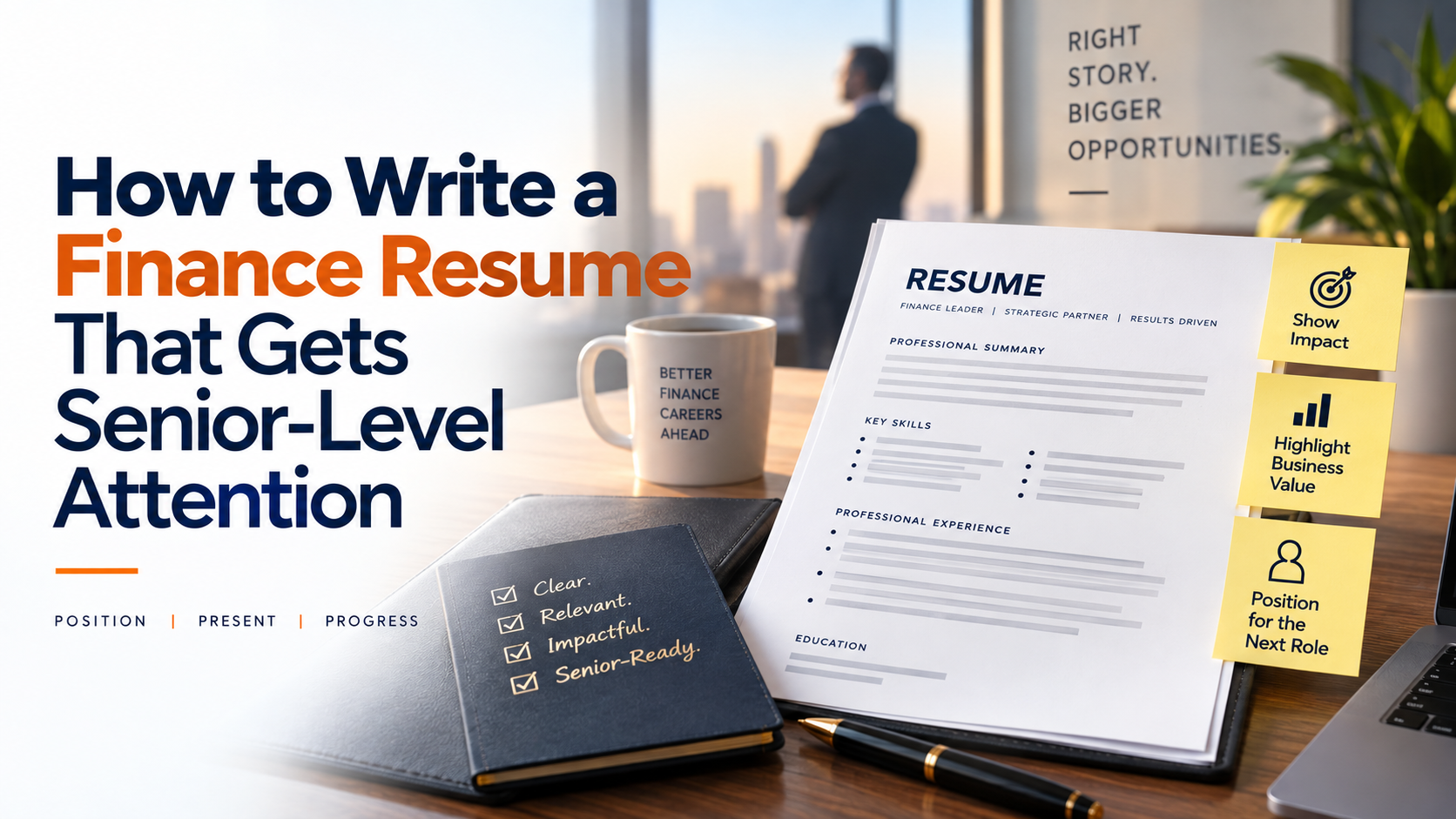
A resume that stands out does not need to be louder. It needs to be clearer about scope, results, and credibility. If you would like a recruiter's view before you apply, our finance search consultants review resumes against live Controller, FP&A, Director, and VP searches every week and will tell you what reads as strong and what reads as generic.