India's e-commerce market reached approximately $159 billion in GMV in 2026, with long-term projections pointing to continued double-digit annual growth. Quick commerce has emerged as a $7–8 billion GMV market as of FY25, expanding at a striking 110–130% CAGR between 2021 and 2025, and is projected to reach $65–70 billion by 2030. The D2C segment is expanding at a pace that is creating consistent demand for senior FP&A professionals across platforms, marketplace sellers, and omnichannel retailers.
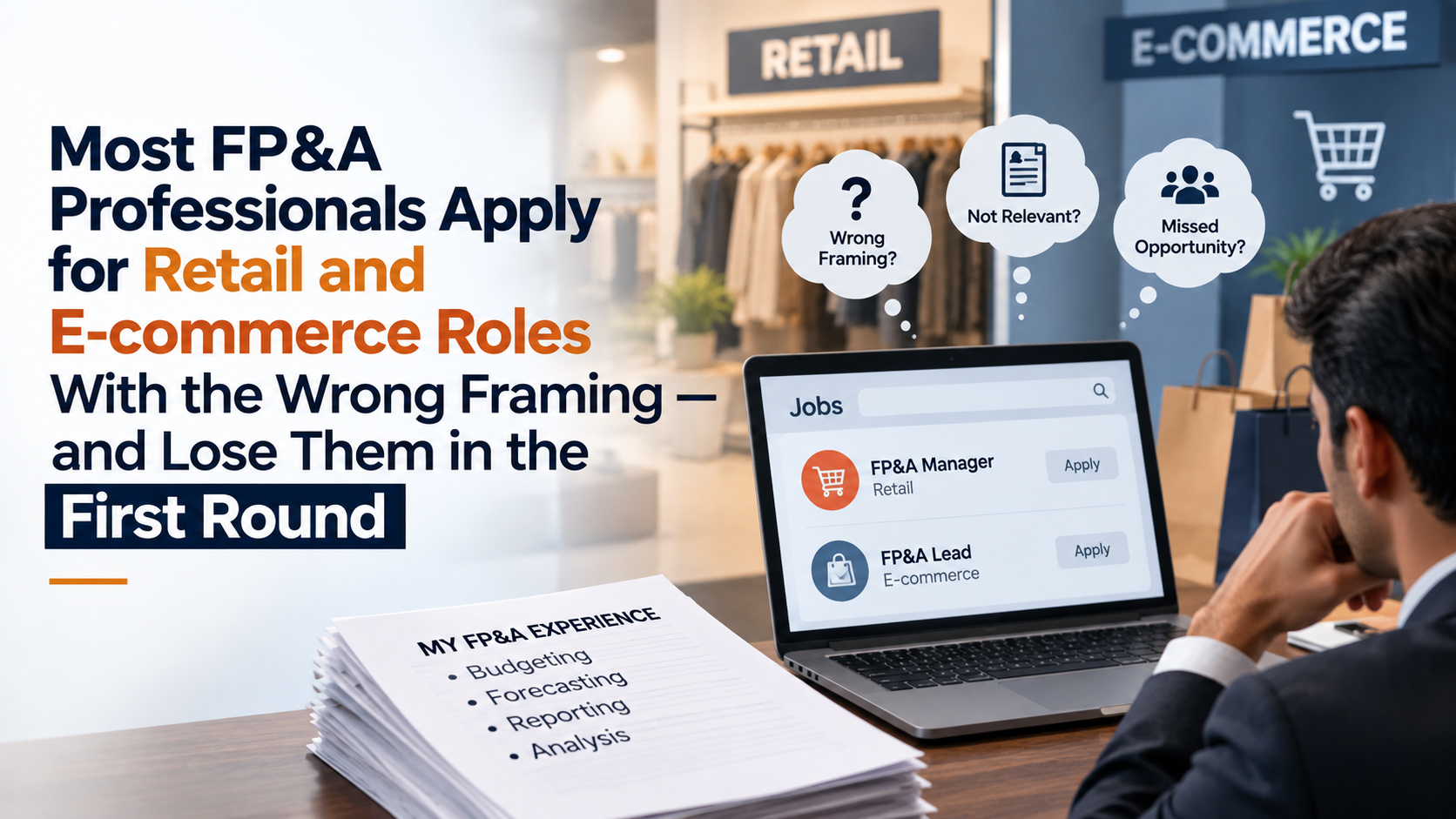
Yet a significant portion of experienced FP&A candidates — even those with strong manufacturing or FMCG backgrounds — are being screened out at the first interview round for retail and e-commerce roles. The reason is almost always the same: they arrive with a traditional FP&A vocabulary and no understanding of the unit economics language that drives every commercial decision in this sector.
If you are a CA, MBA Finance, or CFA targeting FP&A roles at companies like Flipkart, Meesho, Blinkit, Nykaa, Reliance Retail, Tata Cliq, or D2C brands, here is what hiring managers are actually evaluating.
Why Retail and E-commerce FP&A Is Structurally Different
In manufacturing or FMCG, FP&A is built around a standard P&L — revenue, gross margin, EBITDA. The inputs are relatively stable and the cost structure is well-defined.
In retail and e-commerce, the P&L is dynamic and multi-layered. GMV is not revenue. Contribution margin is not gross margin. Customer acquisition cost is not a marketing line item — it is a strategic investment with a payback period that determines whether growth is sustainable or destructive.
At a CAGR of 110–130% between 2021 and 2025, quick commerce is one of the fastest-scaling retail formats India has seen. At that pace of growth, FP&A teams are not managing a stable business — they are modelling a rapidly shifting commercial landscape where the wrong assumptions in a forecast can lead to significant cash burn with no warning.
Hiring managers in this sector are looking for FP&A professionals who understand this environment — not those who are trying to apply a traditional finance lens to a fundamentally different business model.
The FP&A Skills Retail and E-commerce Hiring Managers Actually Test
Unit Economics Fluency — The Non-Negotiable
This is the first filter. If you cannot speak fluently about unit economics — what they are, how they are built, and how they drive decisions — you will not clear the first round at any serious retail or e-commerce company.
Unit economics in this sector means understanding the profitability of a single customer or a single order, not just the aggregate P&L. Panels test whether you can build a contribution margin waterfall from GMV to net revenue to contribution margin after marketing, and whether you understand what each deduction means.
The GMV to Contribution Margin waterfall every FP&A professional must know:
GMV — Gross Merchandise Value (total transaction value before any deductions)
Less: Returns and cancellations (fashion categories in India commonly see return rates in the 15–40% range)
Less: Discounts and promotions (festive sales and first-order discounts can erode a meaningful share of GMV)
Less: Marketplace commissions (typically in the 5–25% range depending on category)
Less: Payment gateway charges (typically 1.5–2.5%)
= Net Revenue
Less: Cost of Goods Sold
= Gross Margin
Less: Fulfilment and last-mile delivery costs
Less: Customer acquisition cost (CAC) allocated to the order
= Contribution Margin
Contribution margin per order is widely treated as the most critical profitability metric in D2C — as a general benchmark, healthy contribution margins tend to fall in the 15% to 30% range of net revenue, though this varies significantly by category and business model. FP&A professionals who arrive at an interview without knowing this waterfall by structure and formula are immediately identifiable as candidates who have not done the foundational work.
Rolling Forecast and Scenario Modelling in a High-Velocity Environment
Retail and e-commerce businesses operate on compressed planning cycles. Festive season planning — Diwali, Big Billion Days, Great Indian Festival — can represent a disproportionate share of annual GMV and requires scenario modelling months in advance.
Hiring managers test whether you have built rolling forecast models that incorporate demand signals — not just historical trends. The candidates who stand out are those who have built models that integrate marketing spend, conversion rate assumptions, category-level AOV (Average Order Value), and fulfilment capacity constraints into a single forecast view.
Weak: Prepared monthly MIS and participated in annual budgeting.
Strong: Built a rolling forecast model for a large omnichannel retailer integrating store-level sell-through rates, online return trends, and marketing spend efficiency — measurably reducing forecast variance across multiple festive cycles.
(Note: quantify this with your own real numbers when you use it in an interview — specific, verifiable figures from your own experience carry far more weight than a generic template.)
CAC, LTV, and Payback Period Analysis
These three metrics determine whether a retail or e-commerce business is building sustainable value or burning cash to generate vanity growth. FP&A professionals in this sector are expected to own these metrics, not observe them.
CAC (Customer Acquisition Cost): Total marketing and sales spend divided by new customers acquired in the period. In interviews, panels test whether you can calculate CAC by channel — paid search, social, affiliate — not just blended.
LTV (Lifetime Value): Gross margin per customer multiplied by expected retention period. The key is using cohort-level retention data, not aggregate averages, to avoid overstating LTV.
Payback Period: CAC divided by monthly contribution margin per customer. A payback period under 12 months is a commonly cited rule of thumb for healthy e-commerce models, though the "right" number depends heavily on category and funding stage.
A widely used industry heuristic is a CAC:LTV ratio of at least 1:3 as a health signal, though the appropriate target varies by business model and should be validated against your specific company's economics rather than treated as a universal rule. A repeat purchase rate above 40% is generally considered a strong indicator of brand strength and sustainable unit economics.
Category P&L Ownership and Channel Profitability
At mid-to-senior FP&A levels in retail, you are expected to own the P&L for a category or a channel — not just consolidate numbers from business teams.
This means understanding how category mix affects blended gross margin, how marketplace take rates differ from D2C margin profiles, and how promotional calendars interact with contribution margin at the SKU level.
Panels test this with scenario questions: "If we shift 15% of our marketplace GMV to D2C, what happens to net revenue and contribution margin?" Candidates who can build that bridge in their head — and explain the assumptions — are the ones who clear this round.
Financial Modelling With Operational Drivers
According to AFP's 2025 FP&A benchmarking data, 82% of FP&A professionals use data connectivity and preparation tools at least quarterly, and 66% use workflow automation tools at least quarterly. (This is a general FP&A industry statistic, not specific to retail or e-commerce, but the underlying shift it reflects — away from static spreadsheets and toward connected data — is especially pronounced in this sector.) In retail and e-commerce, this translates to building models that are connected to operational data — inventory levels, sell-through rates, fulfilment capacity, and digital marketing dashboards — rather than static spreadsheet models updated once a month.
Hiring managers are specifically looking for candidates comfortable with SQL basics, Power BI or Tableau for dashboard-level reporting, and Excel-based dynamic models with scenario toggles. You do not need to be a data engineer — but you need to be able to pull, validate, and use operational data without always depending on a data team.
Key Retail and E-commerce FP&A KPIs — Know These Before Any Interview
Gross Merchandise Value (GMV) Total value of merchandise sold before deductions. It measures scale, not profitability. Never confuse GMV with revenue in an interview.
Net Revenue GMV minus returns, discounts, and commissions. This is the actual topline the business recognises.
Contribution Margin (CM) Formula: Net Revenue – Variable Costs (COGS + Fulfilment + CAC) Commonly cited healthy range for D2C: 15–30% of net revenue (varies by category and stage). This is the primary operating profitability metric in e-commerce.
Customer Acquisition Cost (CAC) Formula: Total Marketing and Sales Spend / New Customers Acquired Track by channel. A blended CAC hides the efficiency of individual acquisition channels.
Lifetime Value (LTV) Formula: Gross Margin per Customer × Average Customer Lifespan Always build LTV on cohort retention curves, not aggregate averages.
LTV:CAC Ratio Commonly cited target: 3:1 or higher, as a general heuristic. Below 1:1 signals the business is likely destroying value with every customer acquired.
Payback Period Formula: CAC / Monthly Contribution Margin per Customer Sub-12-month payback is a frequently cited benchmark for retail and e-commerce models, though this varies by category.
Average Order Value (AOV) Formula: Net Revenue / Number of Orders Drives contribution margin alongside repeat purchase frequency.
Sell-Through Rate Formula: Units Sold / Units Available × 100 Critical for inventory planning and markdown management in retail.
Return Rate Formula: Units Returned / Units Sold × 100 Directly impacts net revenue and fulfilment costs. Category-level return rates vary significantly — fashion and apparel typically run highest.
Retail and E-commerce FP&A: An Illustrative Case Example
The scenario below is a composite, illustrative example built to demonstrate the analytical approach — not a report on a specific, named company. Use it as a template for the kind of story you should be prepared to tell about your own real work.
Situation: A mid-sized D2C beauty brand was growing topline strongly year-on-year but reporting widening losses every quarter. The founding team believed the losses were a function of growth investment and would self-correct at scale.
Problem: The FP&A team was consolidating numbers at the company level but had not built a category-level or channel-level contribution margin view. Marketing spend was being treated as a fixed growth investment rather than being analysed by channel efficiency.
Action: The FP&A Manager segmented the P&L into three channels — the D2C website, marketplaces, and quick commerce. The channel-level analysis revealed that D2C contribution margin was healthy, marketplace contribution margin was thin after commissions and returns, and quick commerce was contribution-negative due to high fulfilment cost per order.
The team then built a channel reallocation model showing that shifting marketing spend from the lower-margin channels toward D2C customer acquisition would improve blended contribution margin meaningfully without sacrificing total GMV.
Outcome: The CFO presented the reallocation case to the board. The marketing budget was restructured, D2C's share of GMV rose materially over the following two quarters, and blended contribution margin moved from negative to positive for the first time in over a year.
The lesson: FP&A in e-commerce creates value when it moves from consolidated reporting to channel-level economic analysis that influences where growth capital is deployed. When you tell this story in an interview, use your own real numbers — panels can tell the difference between a memorized template and lived experience.
5 Real Retail and E-commerce FP&A Interview Questions — With Strong Senior-Level Answers
Q1. Walk me through the difference between GMV and net revenue. Why does it matter for FP&A?
Strong answer: "GMV is the total transaction value before any deductions — it tells you about scale and market share but says nothing about what the business actually earns. Net revenue is what remains after returns, discounts, promotional credits, and marketplace commissions. For FP&A, the gap between GMV and net revenue is where you find the quality of growth — a business growing GMV much faster than its net revenue is becoming less efficient, and that trend needs to be understood and explained before it becomes a problem. I always build my forecasts on net revenue, not GMV, because GMV can mask deteriorating unit economics."
Q2. How would you assess whether our marketing spend is creating sustainable growth or destroying value?
Strong answer: "I would start by calculating CAC by channel — not blended — because a healthy blended number can hide channels with poor underlying CAC:LTV ratios. Then I would build cohort-level LTV using actual retention curves for the last several quarters, because using average retention rates typically overstates LTV. If a channel's CAC payback period stretches well beyond 12 months, I would flag it as a capital efficiency concern. The final test is repeat purchase rate — in D2C, a strong repeat rate is a signal that the product has genuine market fit and that marketing spend is building a real customer base rather than renting attention."
Q3. We are planning a festive season campaign that will require significant incremental marketing spend. How do you evaluate whether this investment makes sense?
Strong answer: "I would build a scenario model that works from the marketing spend back to contribution margin. Starting with the expected incremental GMV from the campaign, I would apply the relevant return rate, discount depth, and fulfilment cost to get to incremental contribution margin. I would then calculate the implied CAC for the new customers acquired and test whether their LTV, based on historical cohort behavior from previous festive acquisitions, justifies the spend. If the implied payback on new customers looks too long, I would present the CFO with a scenario showing a reduced spend level that maintains payback discipline — along with the revenue impact — so the decision is made with clear tradeoffs visible, not just a top-line growth target."
Q4. How do you build a category P&L, and what do you use it for?
Strong answer: "A category P&L starts with net revenue by category after returns and discounts. From there I deduct direct COGS, fulfilment costs allocated by category weight and shipment distance, and category-specific marketing spend including trade promotions and platform-level paid placements. The result is category contribution margin. I use it for three things: identifying which categories are subsidising which, informing the promotional calendar — categories with tight contribution margins should not be running deep discount promotions — and making the case for investment in high-margin, high-repeat categories where CAC efficiency is strongest."
Q5. Our CFO wants a 13-week cash forecast. How would you build it for a retail business with significant inventory seasonality?
Strong answer: "For a retail business, the 13-week cash forecast has three primary drivers — collections from customers, inventory payments to vendors, and operating expense run-rate including marketing and fulfilment. On the collection side, I would model by channel: D2C collections are typically fast, while marketplace settlements often lag by one to two weeks post-delivery. On the vendor payment side, I would integrate the procurement calendar with inventory build requirements for seasonal categories. The model would have a weekly toggle for GMV assumption scenarios, which automatically cascades through to collections, payment gateway timing, and net cash position. I would flag weeks where cash headroom drops below a threshold and present the CFO with levers — accelerate collections, defer discretionary marketing, or draw on working capital facility."
Common Mistakes FP&A Professionals Make When Targeting Retail and E-commerce Roles
Framing all FP&A experience in traditional P&L language. Saying "managed budgeting and variance analysis" in a retail interview tells the panel nothing about whether you understand contribution margin, CAC, or unit economics. Translate your experience into the language of the sector before applying.
Confusing GMV with revenue in an interview. This is one of the fastest ways to lose credibility with a retail or e-commerce hiring panel. They will often test this explicitly in the first ten minutes.
Presenting LTV figures without cohort-level validation. Using blended average retention to calculate LTV is a known shortcut. Panels at sophisticated companies will ask how you built your LTV — and if your answer relies on averages rather than cohort curves, you will be pressed.
Underestimating the importance of return rate analysis. Return rates in Indian e-commerce — particularly in fashion and electronics — are material enough to significantly distort revenue recognition. FP&A professionals who treat returns as a footnote rather than a core driver will miss key insights panels expect you to volunteer.
Arriving without knowledge of the company's channel mix or GMV trajectory. For listed companies like Nykaa or Zomato, this information is in public filings. For funded startups, it is often in press coverage or investor announcements. Walking in without this context signals low commercial interest.
Salary and Hiring Trends for Retail and E-commerce FP&A Roles in India
Demand for senior FP&A professionals in retail and e-commerce is concentrated across three types of organisations — large listed platforms, PE-backed and VC-funded D2C brands, and omnichannel retailers expanding their digital footprint.
At the FP&A Manager level with 8–12 years of experience, compensation in established platforms and large omnichannel retailers commonly ranges roughly from ₹25–55 lakh CTC, though this varies by company, city, and specific role scope — treat this as a directional benchmark rather than a precise figure, and validate against current market data (e.g. Glassdoor, AmbitionBox, or a specialist recruiter) before negotiating. At funded D2C companies and growth-stage startups, fixed components may be lower but ESOP structures can add meaningful upside — though panels will remind you that ESOP value depends on the company's exit trajectory.
The strongest hiring demand in 2026 is for professionals who combine traditional FP&A rigour with digital commerce fluency — specifically, candidates who can own a category P&L, build contribution margin models, and translate unit economics into strategic recommendations for the CFO or founders.
Mock Interview Checklist for Retail and E-commerce FP&A Roles
Use this before your next interview. If you cannot answer each point with a specific example from your own experience, that is a gap to address before you apply.
- Can you explain the GMV to contribution margin waterfall — including all the deductions and why each matters?
- Can you calculate CAC by channel and explain why blended CAC is insufficient for decision-making?
- Can you describe how you have built or used LTV, and whether your approach used cohort-level retention or aggregate averages?
- Can you walk through a scenario where you identified a channel or category that was growing GMV but destroying contribution margin?
- Can you build a 13-week cash forecast for a retail business with seasonal inventory — and explain your assumptions out loud?
- Have you reviewed the target company's last investor presentation, annual report, or publicly available financial disclosures?
- Can you explain what sell-through rate is, how it is calculated, and how it connects to markdown decisions and working capital?
- Can you articulate why return rate matters for FP&A in e-commerce — and give a specific example of how it affected a financial outcome in your career?
Retail and e-commerce FP&A in India is one of the most commercially demanding and intellectually challenging environments for senior finance professionals. The sector rewards those who combine financial rigour with genuine commercial instinct — and it exposes, quickly, those who are still operating as reporting functions rather than strategic partners. The unit economics language of this sector is learnable. The candidates who take the time to learn it before their next interview are the ones who walk out with offers.