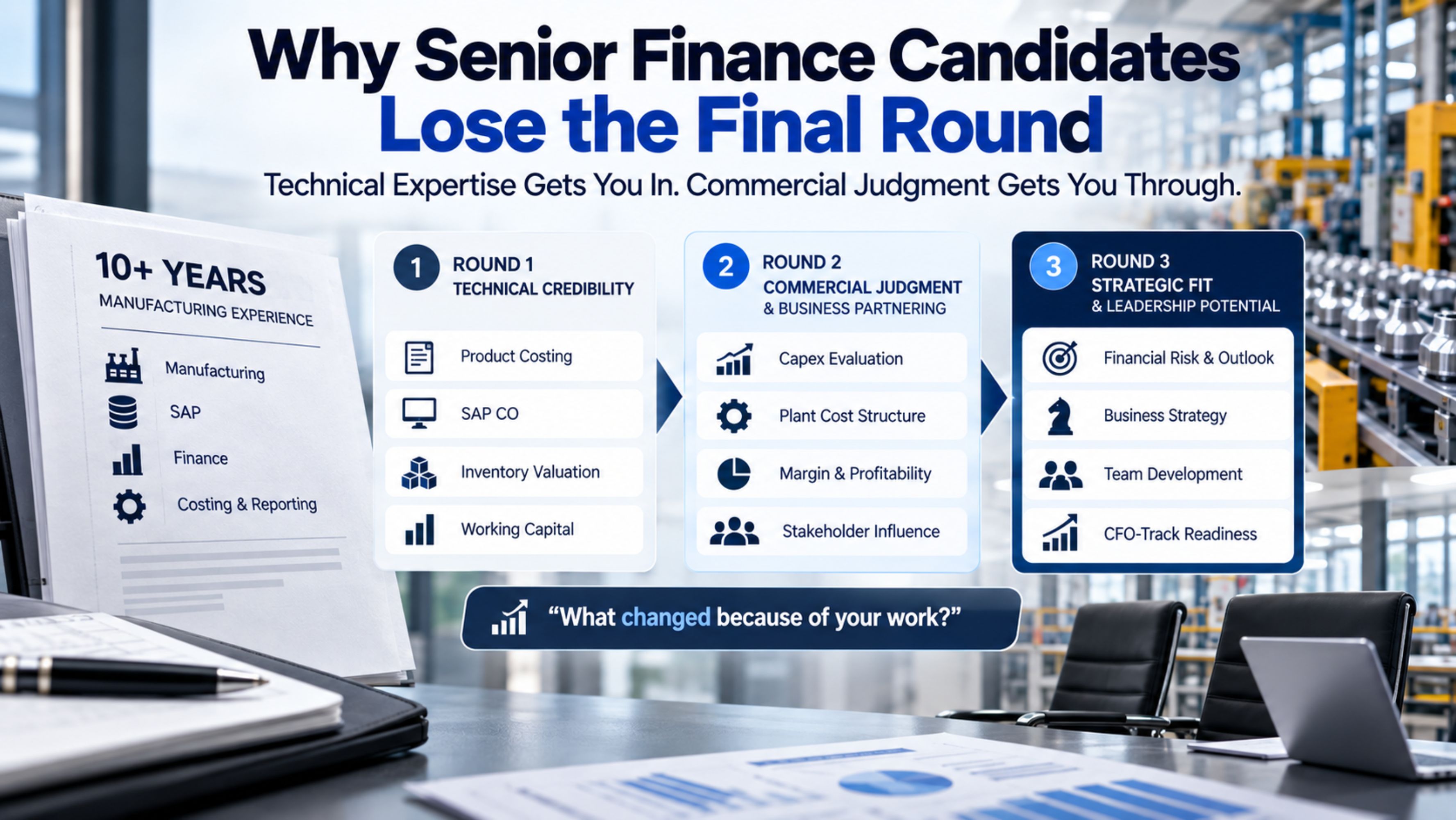
You Have the Experience. Here Is Why the Final Round Is Still Slipping Away.
Many Finance Managers and Controllers with a decade of solid manufacturing experience clear the first round comfortably — and then lose the final panel to someone with comparable credentials.
The gap is rarely qualifications. It is preparation at the wrong level.
Senior hiring panels at Indian manufacturers — listed companies, MNC subsidiaries, and PE-backed mid-caps — are not running final rounds to verify your technical knowledge. They assume that. What they are testing is whether you have moved beyond producing financial information to actually influencing decisions made with it.
India's manufacturing sector currently contributes around 17% to GDP, with the government targeting a rise to 25% by 2035 and the creation of 143 million jobs. That scale of expansion is creating senior finance roles — but also raising the evaluation bar for who fills them.
Here is what each round of a senior manufacturing finance interview is actually testing, and how to walk in prepared.
Why the Interview Bar Has Shifted
Manufacturing CFOs no longer build finance teams to report what happened last month. They want finance managers who influence what happens next — capex allocation, plant cost structure, vendor payment strategy, and working capital deployment.
Realized investments under the PLI scheme reached approximately ₹1.76 lakh crore by March 2025, with 806 approved applications moving from approval to active implementation. Companies absorbing that level of capital investment need finance leaders who can operate at the decision-making table, not just behind it.
The interview process has been restructured accordingly.
What Each Round Is Actually Evaluating
Round One — Technical Credibility
This round is typically run by the Finance Controller or a senior finance leader. It establishes whether you can be trusted with the technical work the role demands.
Expect specific questions on:
- How you have structured product costing — standard, actual, or activity-based — and why
- How you managed period-end close in SAP CO, including production order settlement and variance disposition
- How you handled Ind AS 2 inventory valuation when raw material costs were volatile
- Your working capital cycle — not textbook definitions, but the actual numbers from your own plant or business
What panels are listening for: Specificity. Not "managed cost accounting" but "rebuilt the standard costing model for a ₹350 crore auto components plant, identifying ₹9 crore in overhead misallocation across three cost centres that had gone undetected for two years."
If your answers describe processes rather than outcomes, you will not clear this round at a senior level.
Round Two — Commercial Judgment and Business Partnering
This round is usually run by the CFO or a business unit head. It moves away from technical verification into how you think and how you influence.
Common questions at this stage:
- "Tell me about a time you disagreed with a plant head on cost allocation. What happened?"
- "Walk me through a capex proposal you evaluated. What did you challenge, and why?"
- "How do you explain a significant adverse variance to an MD who does not have a finance background?"
For manufacturing roles specifically, panels test whether candidates can speak fluently to the metrics that define the sector — inventory turnover, gross margin, EBITDA, working capital, and cash flow conversion cycle — and connect them to operational decisions.
What panels are listening for: Evidence that finance has a seat at the operational table — not that it provides commentary after decisions are already made.
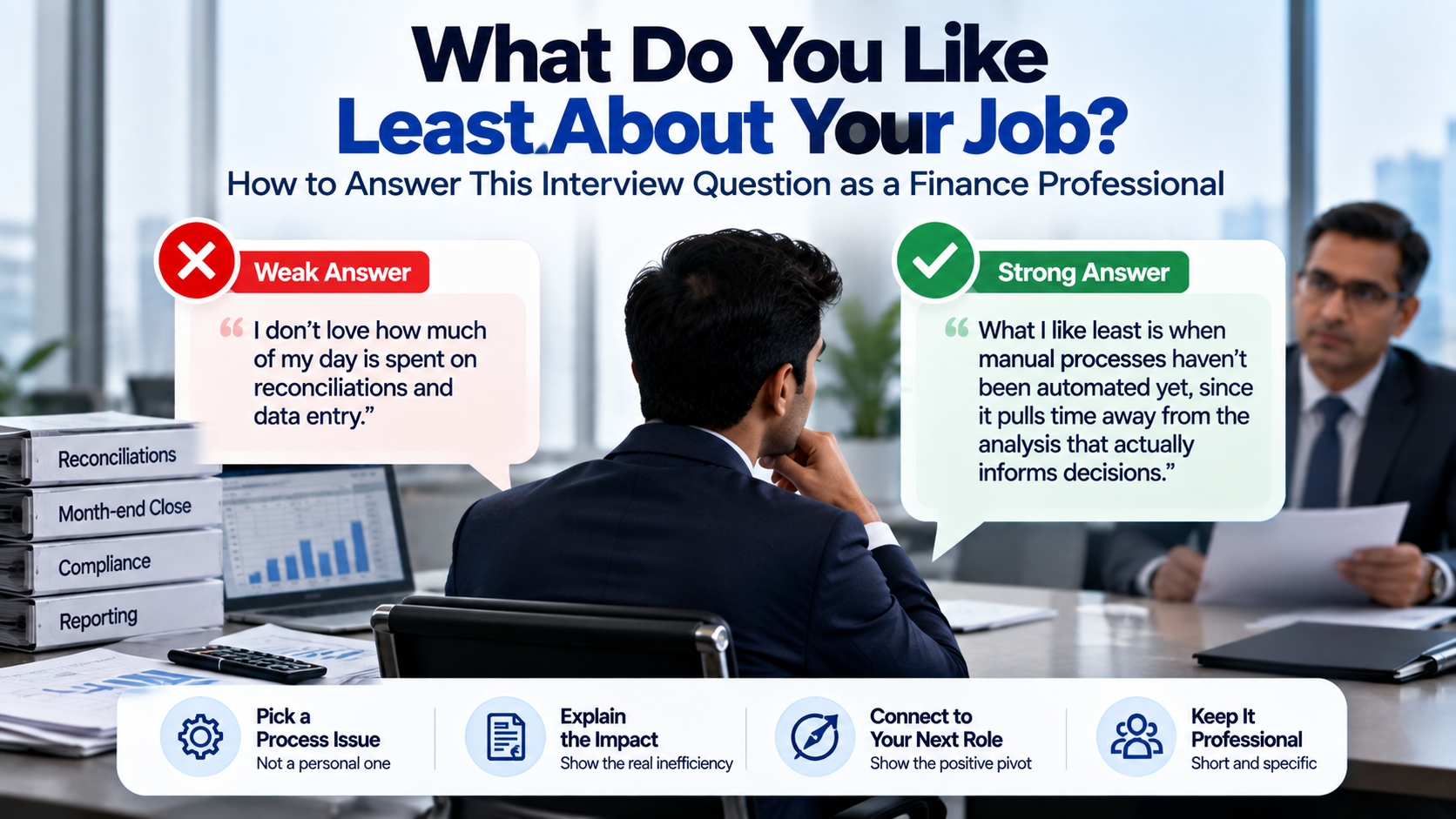
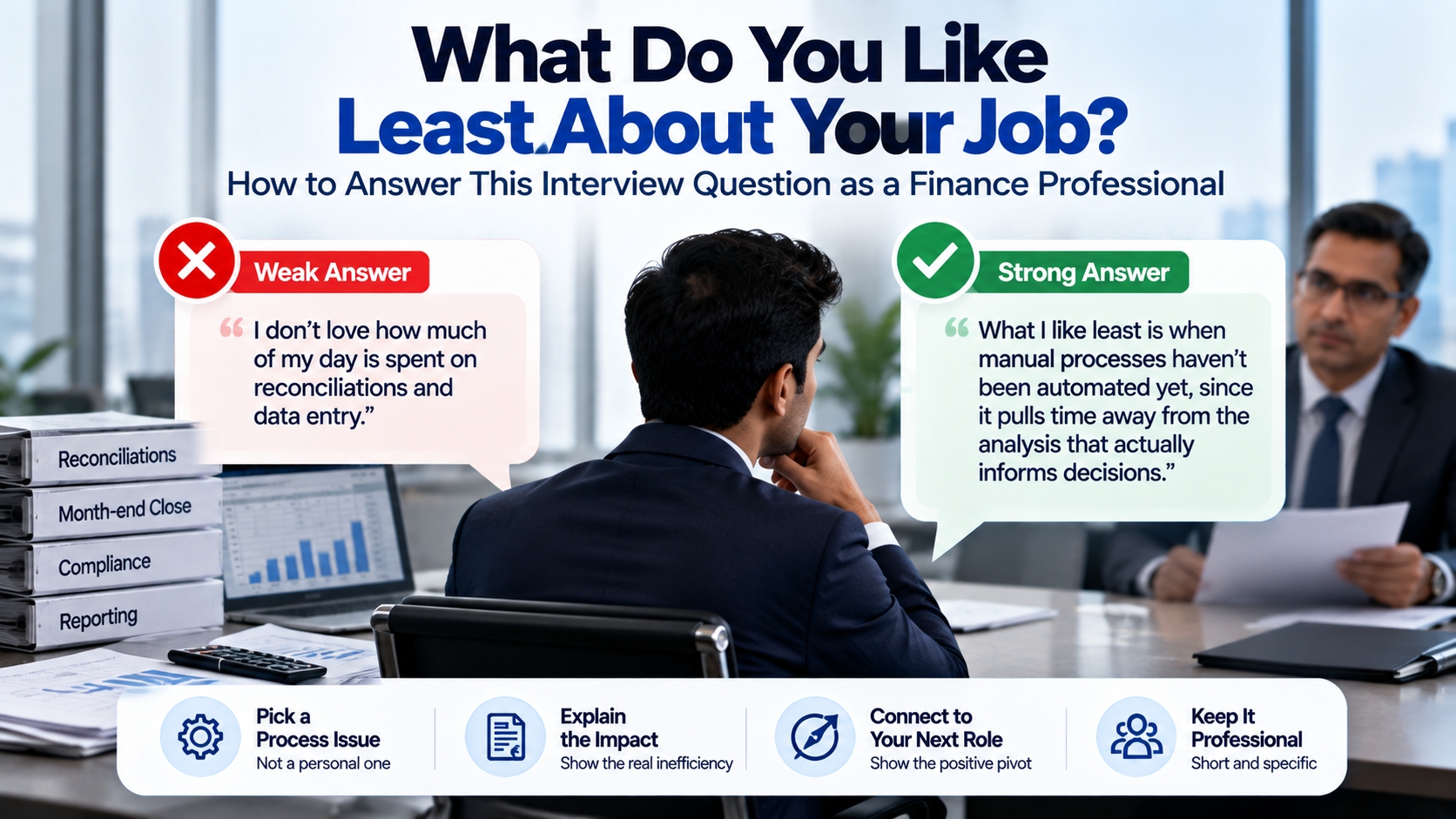
Weak answer: "I presented the monthly variance report to management."
Strong answer: "When our paint line showed a ₹2.8 crore adverse overhead absorption variance for the third consecutive month, I pulled in the production planning team. We found that unplanned maintenance outages were driving idle machine time that was being absorbed into standard cost. We revised the maintenance scheduling model and the variance dropped by over 60% within two quarters."
The second candidate gets the offer. The first gets a polite rejection email.
Round Three — Strategic Fit and Leadership Potential
This is the MD round at mid-cap manufacturers, or the Regional CFO round at MNC subsidiaries. It has one purpose: to assess whether you can grow into a Head of Finance or CFO-track role within the organisation.
Questions typically include:
- "What do you see as the biggest financial risk in our sector over the next 18 months?"
- "If you joined us tomorrow, what would you change about how the finance function operates here?"
- "Give me an example of how you have developed someone on your team."
What the panel is looking for is self-awareness, genuine commercial curiosity, and the ability to think about the business beyond your own function. Candidates who have done no preparation on the company's financials before walking into this round rarely recover.
The Three Things That Separate Shortlisted Candidates
Quantified Stories With Operational Context
Every experienced manufacturing finance professional has managed budgets, run variance analysis, and closed books. The question is not whether you have done these things. It is what changed in the business because you did them.
Before your interview, build five career stories. Each should cover:
- The business context — revenue scale, number of plants, product complexity
- The specific problem or opportunity you identified
- How you influenced a non-finance stakeholder to act
- The outcome, in numbers
If you cannot attach a number to the outcome, keep refining the story until you can.
Operational Vocabulary
Finance professionals who have maintained close engagement with the shop floor consistently outperform those who have operated from within the finance function alone. Panels test whether you can speak the operational language of manufacturing — capacity utilisation, OEE, yield loss, throughput, BOM accuracy — and translate it into financial terms.
You do not need to be an engineer. You need to demonstrate that you understand how operational decisions drive financial outcomes, and that you have used that understanding to add measurable value.
Company-Specific Preparation
Walking into a final round without knowing the company's margin trends, working capital cycle, and capex intensity is the single most common reason strong candidates are passed over at the senior level.
If the company is listed, read the last two annual reports and the most recent investor presentation. Understand where their pressure points are. If the company is unlisted, study their sector — input cost dynamics, PLI exposure if applicable, and customer concentration risks.
PLI disbursements are tied to annual audited financials, production verification, and investment proof — finance managers at PLI-beneficiary companies are expected to own this compliance process. If your employer has PLI exposure and you have hands-on involvement in incentive tracking and claim filing, position that explicitly. It is a differentiating skill that most candidates do not mention.
Common Mistakes Senior Finance Professionals Make in These Interviews
Describing process instead of outcome. Saying "I was responsible for variance analysis and MIS reporting" tells the panel nothing about your judgement or impact. At this level, every bullet — and every spoken answer — needs to end with what changed.
- Overstating SAP depth. Panels at manufacturers will probe your SAP CO experience specifically — settlement profiles, costing variants, product cost planning. Candidates who claim broad SAP expertise without being able to discuss module-level transactions lose credibility quickly. Be precise about what you have actually worked in.
- Arriving without company-specific knowledge. At the senior level, this is interpreted as low motivation — not modesty. Even 90 minutes of focused research on the company's financials will separate you from the majority of candidates.
- Giving generic answers to strategic questions. When a CFO asks what you would change about the finance function, "improve processes and add controls" is a placeholder, not an answer. If you have done the research, you can say something specific — and specificity is what gets remembered after the room empties.
Underselling cross-functional influence. If your best work happened because you engaged with the production team, the supply chain head, or the MD — say so clearly. The panel needs to hear that finance in your hands operates as a business partner, not a reporting function.
Action Checklist Before Your Next Senior Interview
- Build five quantified career stories — each with business context, non-finance stakeholder influenced, action taken, and measurable outcome
- Map your SAP experience to specific modules and be ready to walk through a concrete period-end scenario
- Research the target company's last two annual reports — understand their margin trends, working capital cycle, and capex intensity before you walk in
- Prepare a specific, researched answer to "what would you change about our finance function"
- Practice translating operational metrics — OEE, capacity utilisation, inventory turns — into financial impact using examples from your own career
- If your employer has PLI exposure, document your role in incentive tracking and compliance explicitly on your resume and in your interview preparation
Prepare two or three intelligent questions for the CFO round that show you have thought about the business, not just the job description
Senior manufacturing finance interviews in India are designed to find one specific type of candidate — someone who has operated as a business partner and can demonstrate it with evidence, not assertion. Technical depth gets you into the room. Commercial judgment, operational fluency, and deliberate preparation get you the offer. The candidates who consistently clear final rounds are the ones who have prepared with the same rigour they would bring to a board presentation.