
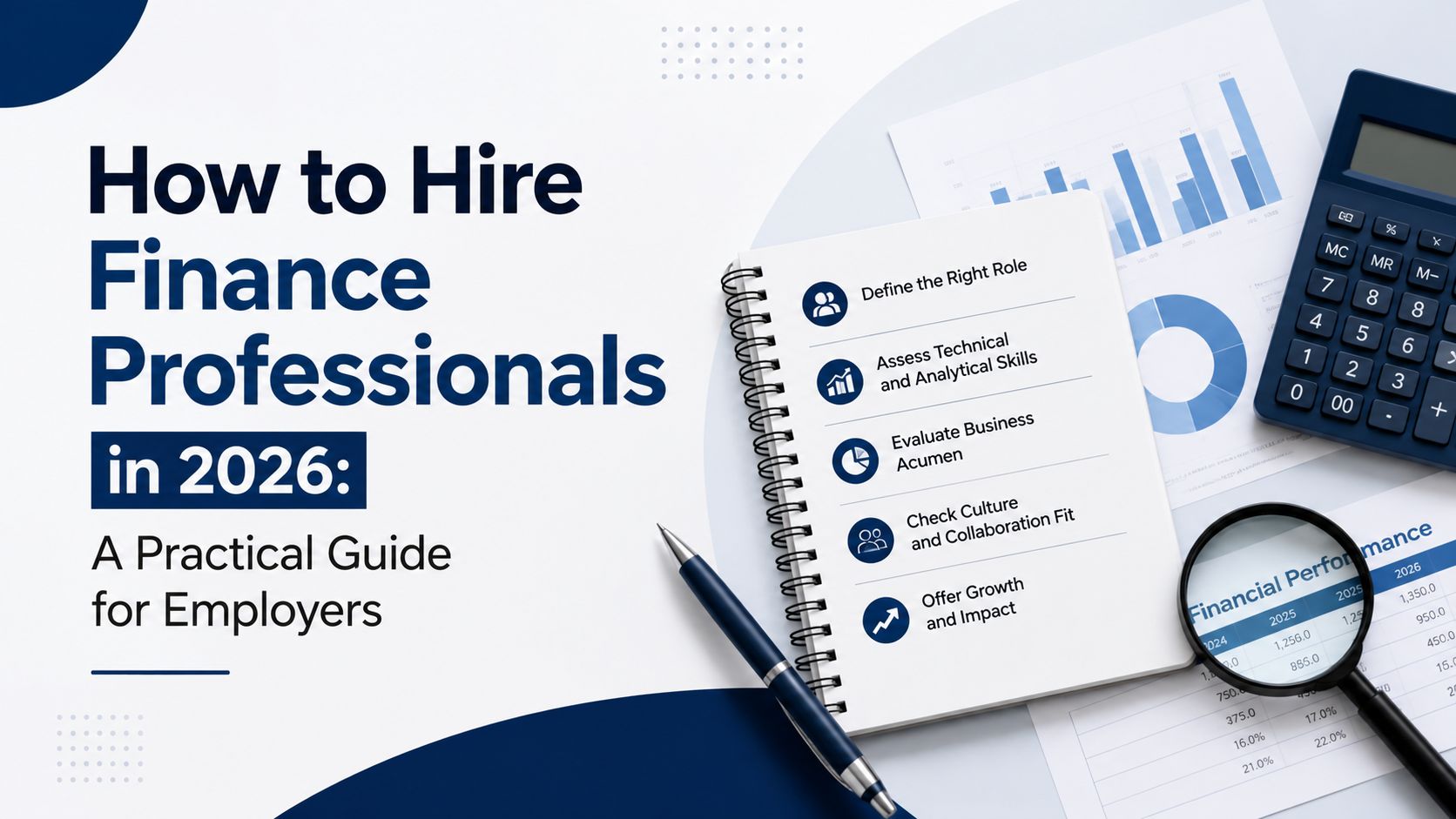
Finance hiring in 2026 looks different than it did even two years ago. Budgets are tighter, scrutiny on every new hire is higher, and the skill set companies need has shifted — technical accounting knowledge is now the baseline, not the differentiator. Hiring intentions remain strong even so: UK financial services leaders surveyed by KPMG in early 2026 reported that 55% of firms plan to hire more staff than they did the year before, and US finance and accounting leaders report a similar pattern of sustained demand — which means the competition for strong finance talent hasn't slowed down even as hiring has gotten more disciplined.
This guide covers what's actually changed in finance hiring this year, which roles are in highest demand, the most common mistakes companies make, and a practical framework for hiring finance professionals — from a senior analyst to a CFO — without losing strong candidates to a slow or generic process.
The State of Finance Hiring in 2026
Three shifts define the market right now:
- Hiring for immediate impact, not potential. Finance leaders are under pressure to control spending even as revenue expectations stay strong, which means new hires are expected to show measurable value quickly rather than grow into the role over a year or two.
- Digital and AI fluency is now a baseline expectation. Technical accounting skill alone no longer differentiates candidates — comfort with automation, reporting tools, and AI-assisted analysis is increasingly the deciding factor between similarly qualified finance candidates.
- Contract and fractional finance talent is growing fast. Roughly 70–75% of finance and accounting leaders report increasing their use of contract talent in the second half of 2026, signaling a real shift toward flexible staffing models rather than default full-time hiring for every open seat.
Underneath these shifts, hiring intentions remain positive — more than half of financial services firms surveyed expect to grow headcount in 2026 — but the bar for who gets hired, and how fast, has risen.
What's Actually Different About Hiring Finance Talent in 2026
Every New Hire Needs a Clear ROI Case
Companies are no longer hiring finance professionals on trajectory or potential alone. Before you open a requisition, you should be able to answer: what specific problem does this hire solve in the first 90 days — faster close, better forecast accuracy, stronger audit readiness, improved cash visibility? If you can't answer that, your job posting won't either, and candidates will notice.
New Roles Are Emerging From Regulation and Payments Infrastructure
The shift to faster payment settlement and broader adoption of real-time payment rails is creating demand for skills in trade matching, exception management, and collateral optimization — roles that barely existed a few years ago. It's also expanding hiring in treasury, cash management, and fraud/AML analytics, as faster payments raise the operational risk that finance and compliance teams need to manage. If you're hiring in banking, payments, or treasury functions, expect a smaller and more specialized candidate pool than in prior years.
Digital Asset and Regulatory Fluency Is a Growing Requirement
As institutions increasingly work with tokenized assets, crypto-linked products, and blockchain-based payment systems, professionals who understand digital asset regulation and custody are seeing rising demand — particularly in securities and wealth management hiring. Even outside of banking, finance leaders are expected to navigate faster-moving and more complex regulatory requirements than in previous years.
Fractional and Contract Hiring Is No Longer a Stopgap
Where contract finance talent used to be a short-term fix for a gap, it's increasingly a deliberate staffing strategy — used to access senior expertise (like an interim CFO or fractional Controller) without the cost or timeline of a full-time executive search, or to flex finance capacity up during a close, audit, or system implementation without adding permanent headcount.
In-Demand Finance Roles for 2026
Demand is running highest for roles that combine traditional finance skill with process and systems ownership — Accounting Managers who can lead teams through close and system transitions, and Senior Financial Analysts who can own forecasting accuracy rather than just build reports, are two of the most competitively hired roles in 2026. Controllers and Directors of Finance remain the most search-intensive senior hires, typically filled through networks rather than public postings.
| For current compensation benchmarks, see our Salary Navigator - Finance Roles (2026) |
Common Mistakes Companies Make When Hiring Finance Professionals
- Writing job descriptions around duties, not outcomes. A posting that lists "manage month-end close" attracts candidates who can perform the task. A posting that states "reduce close cycle from 10 days to 5" attracts candidates who've actually done it.
- Screening resumes for keywords instead of scope. Two Controller candidates can list identical duties, but one may have run close for a $10M single-entity business and the other for a $200M multi-entity company. Screening on keywords alone misses this — screening on scope catches it.
- Moving too slowly on senior candidates. Strong Director and VP-level finance candidates are typically fielding multiple conversations at once; hiring teams commonly find that a process taking 6–8 weeks to reach an offer loses candidates to companies that move in 3–4.
- Underweighting digital/AI fluency in technical screening. Many finance interview processes still test only technical accounting knowledge. In 2026, that leaves a real gap — candidates should also be assessed on their comfort with automation, reporting tools, and AI-assisted analysis, since that's increasingly what separates strong performers.
- Defaulting to full-time hiring when fractional talent would solve the problem faster. If you need senior-level expertise for a specific project (a system implementation, an audit, an interim leadership gap), a 9-month full-time search may be the wrong tool. Fractional or contract talent can often fill the need in weeks.
A Step-by-Step Framework for Hiring Finance Professionals in 2026
1. Define the outcome, not just the role. Before writing the job description, write down the two or three measurable outcomes this hire needs to deliver in year one.
2. Decide FTE vs. fractional/contract before you post the role. If the need is project-based or leadership-gap-driven, fractional talent may be faster and lower-risk than a full-time search.
3. Build screening criteria around scope, not just skills. Compare candidates on the size and complexity of the business they've operated in, not just the tools and duties listed on their resume.
4. Assess digital and AI fluency directly. Add at least one interview question or exercise that tests comfort with automation and modern reporting tools, not just technical accounting knowledge.
5. Compress your timeline for senior roles. For Director-level and above, aim to move from first interview to offer in 3–4 weeks; longer timelines meaningfully increase the risk of losing strong candidates to competing offers.
6. Benchmark compensation against current-year data, not last year's budget. Pay ranges have moved; using outdated benchmarks is one of the most common reasons companies lose finalist candidates late in the process.
7. Bring in specialist support for Director-level roles and above. Most senior finance roles are filled through networks and search relationships rather than public job postings — a finance-focused search partner typically has access to passive candidates who aren't actively applying anywhere.
Full-Time vs. Fractional/Contract Finance Talent: Which Should You Hire?
Situation | Better Fit |
| Ongoing, permanent function (Controller, FP&A lead) | Full-time hire |
| Need senior expertise for a specific project (audit, ERP implementation, M&A) | Fractional/contract |
| Leadership gap during a search or transition | Interim/fractional executive |
| Seasonal or close-cycle capacity crunch | Contract support |
| Building a long-term finance leadership team | Full-time hire, sourced via retained search |
How a Finance-Focused Recruitment Search Firm Helps
A generalist hiring process often struggles with two things specific to finance roles: evaluating scope accurately (is this Controller candidate really operating at the complexity your business needs?) and reaching senior candidates who aren't actively browsing job boards. A finance-specialist search firm typically closes both gaps — bringing pre-vetted candidates whose scope has already been assessed, and direct access to passive senior talent through existing relationships, which shortens time-to-hire for the roles where a slow process costs you the best candidates.
Hiring finance talent in 2026 rewards speed and precision — companies that define outcomes clearly, screen for real scope, and move quickly on senior candidates are winning the best hires. If you're opening a Controller, Director, or VP-level finance search, our finance recruiting practice can help you move faster with a shortlist that's already been assessed for scope and fit.


