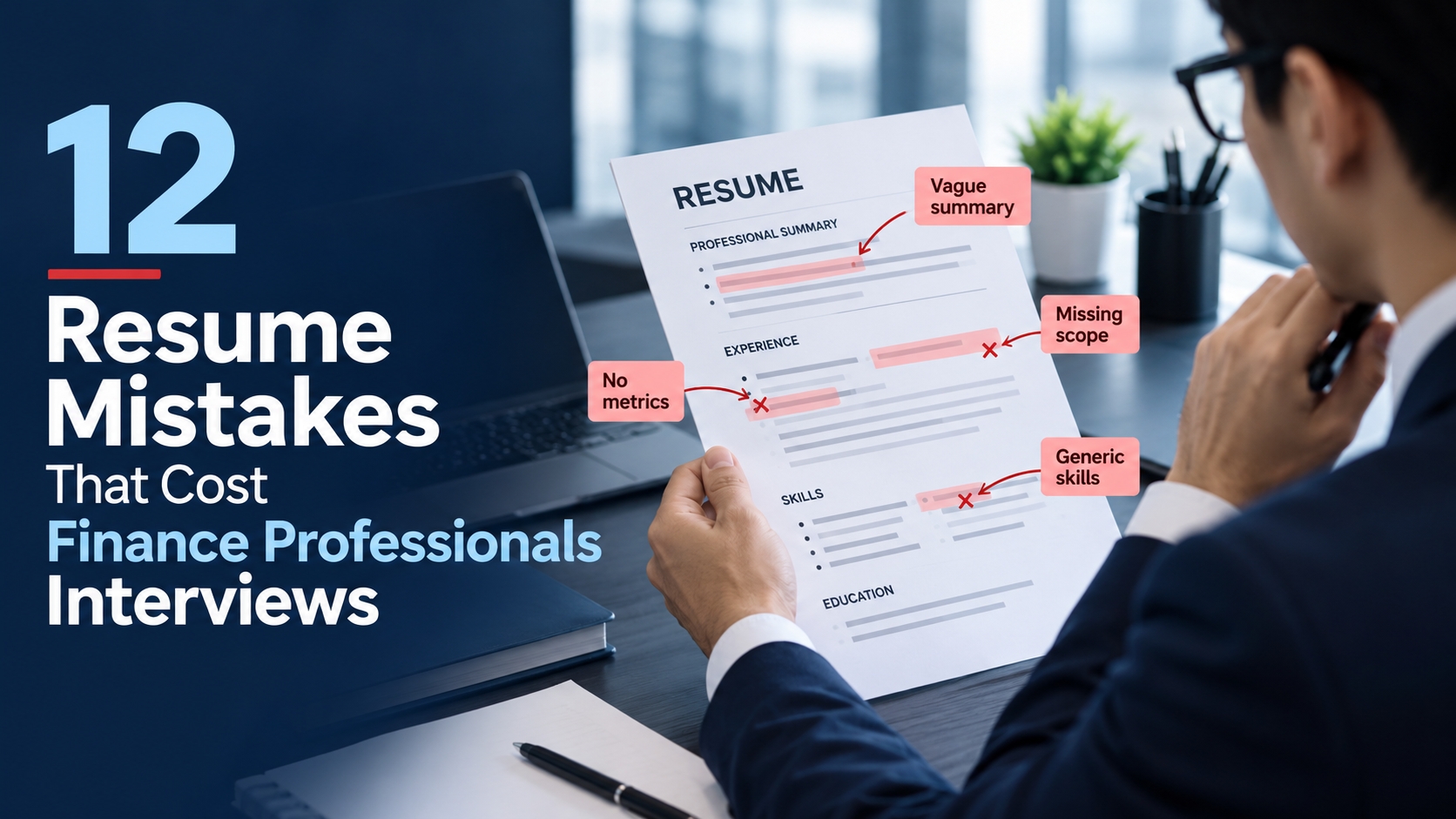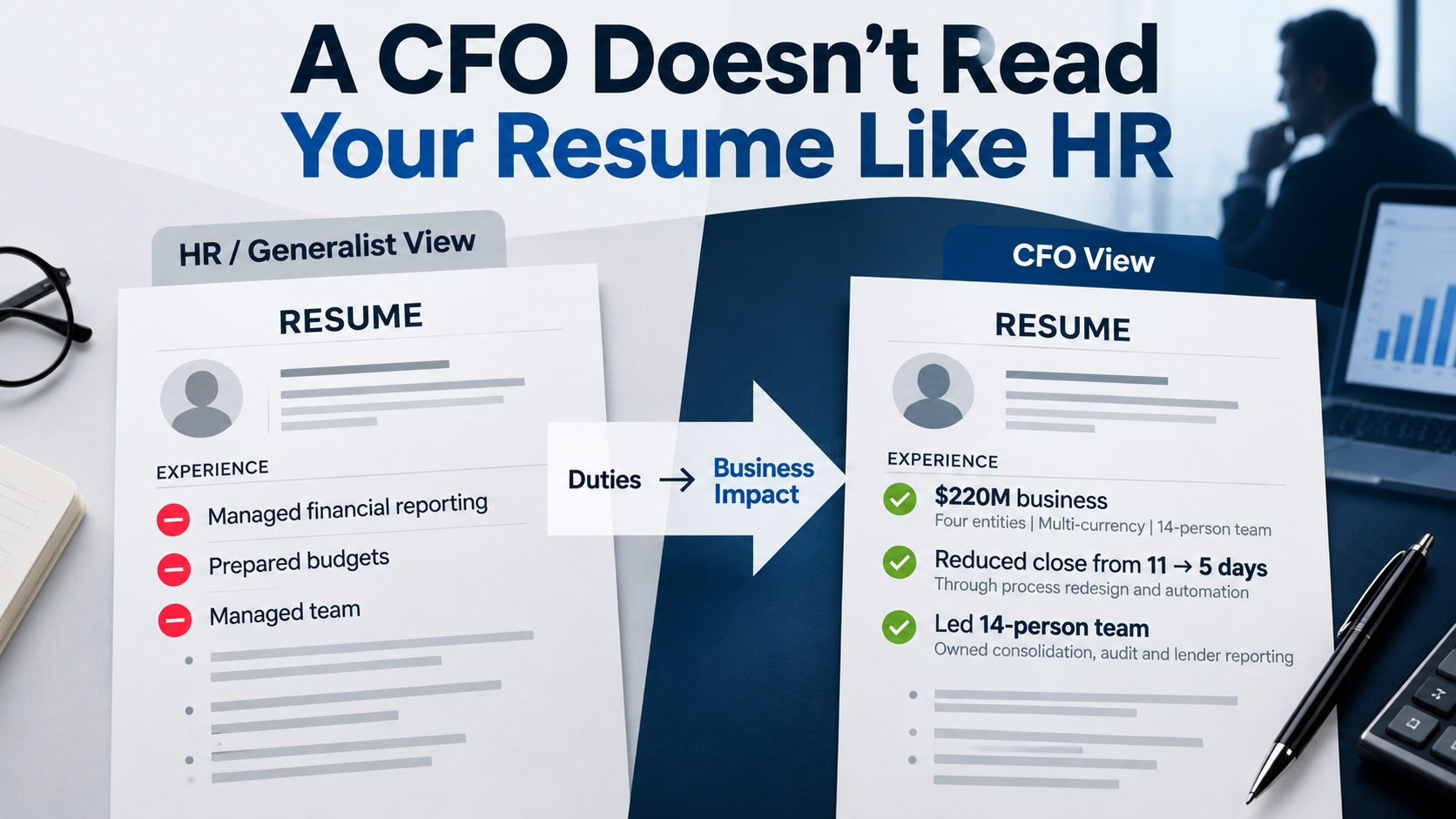
Most finance professionals write their resume for an applicant tracking system or a generalist recruiter. But for Controller, FP&A Director, VP Finance, and other senior finance roles, the person who makes the final call is usually the CFO — and CFOs read resumes very differently from HR.
A CFO isn't scanning for keywords. They're scanning for risk and return: Can this person be trusted with our numbers, and will they make my function and my business better? Your resume has to answer both questions quickly, because the first pass is short. Estimates of how long an initial screen lasts vary widely by study and by role — from a few seconds to roughly half a minute — but every credible source agrees on one thing: the impression forms early, and it forms from the top of the page.
Here's what CFOs look for, drawn from the patterns we see when we present finance candidates to CFO clients, along with weak vs. strong examples you can use to fix your own resume.
1. Scope: How Big and How Complex Was Your Remit?
The first thing a CFO wants to know is whether you've operated at the scale and complexity of the seat they're filling. A Controller for a $15M single-entity business and a Controller for a $300M multi-entity, multi-currency group are doing very different jobs under the same title.
Weak: "Controller responsible for accounting operations and financial reporting."
Strong: "Controller for a $220M, four-entity manufacturer with operations in the US and Mexico; led a 14-person accounting team and owned consolidation, audit, and lender reporting."
Fix: State revenue, entity count, currencies, team size, and ERP in the first two lines of each role. If figures are confidential, use ranges ("$150–250M revenue").
2. Business Outcomes, Not Task Lists
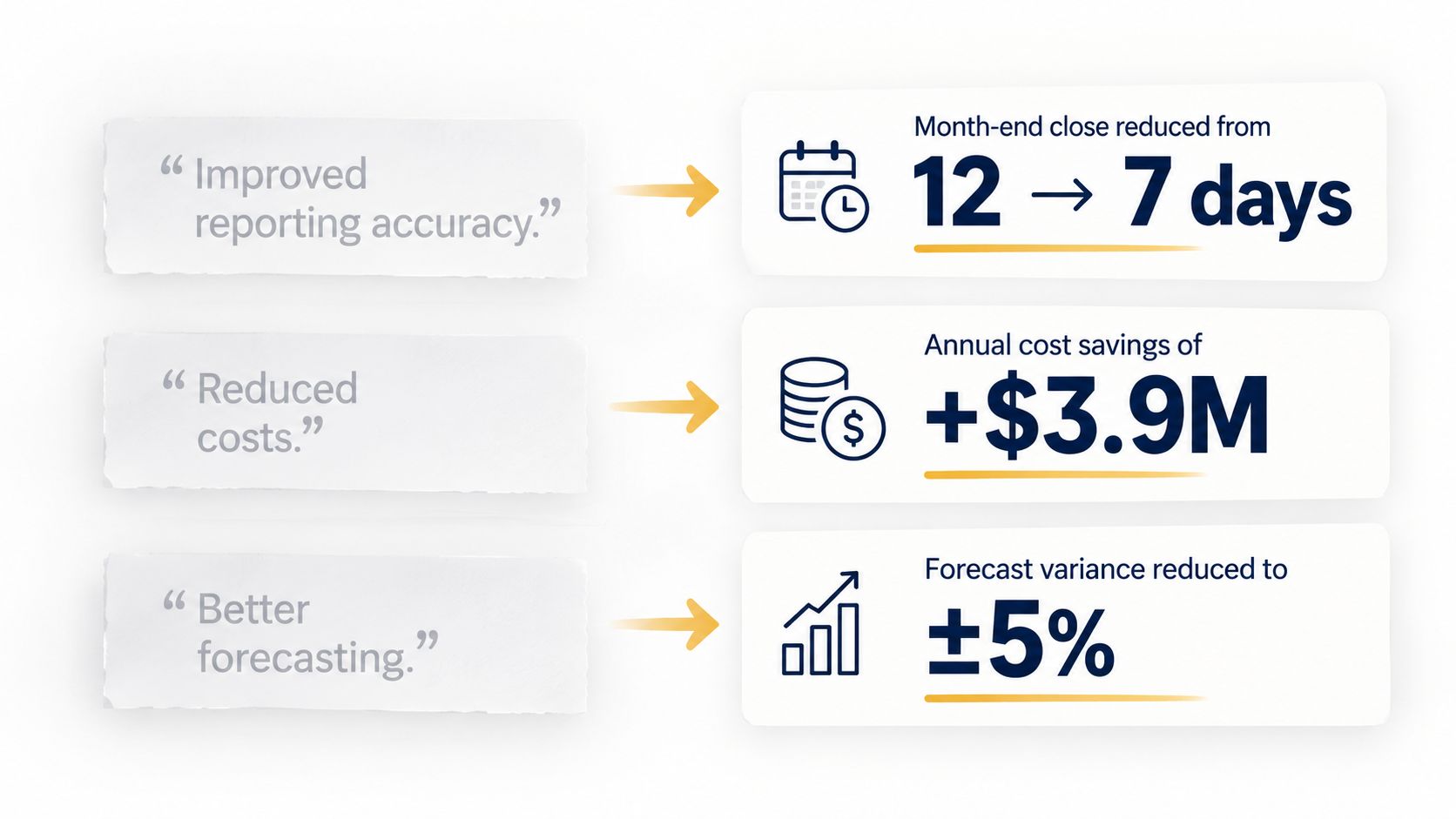
CFOs are under constant pressure to justify every dollar of finance spend. A resume that lists recurring tasks (close, reporting, budgeting) describes the job. A resume that shows what changed because you were there describes the return.
Weak: "Managed month-end close and prepared financial statements."
Strong: "Cut month-end close from 11 to 5 business days by redesigning the close calendar and automating intercompany reconciliations, giving the CFO reliable numbers a week earlier each month."
Fix: Use the pattern action + process/system + measurable result + who benefited. Time saved, cost removed, accuracy improved, risk avoided, and cash released are the outcomes CFOs care about most.
3. Commercial Judgment and Business Partnering
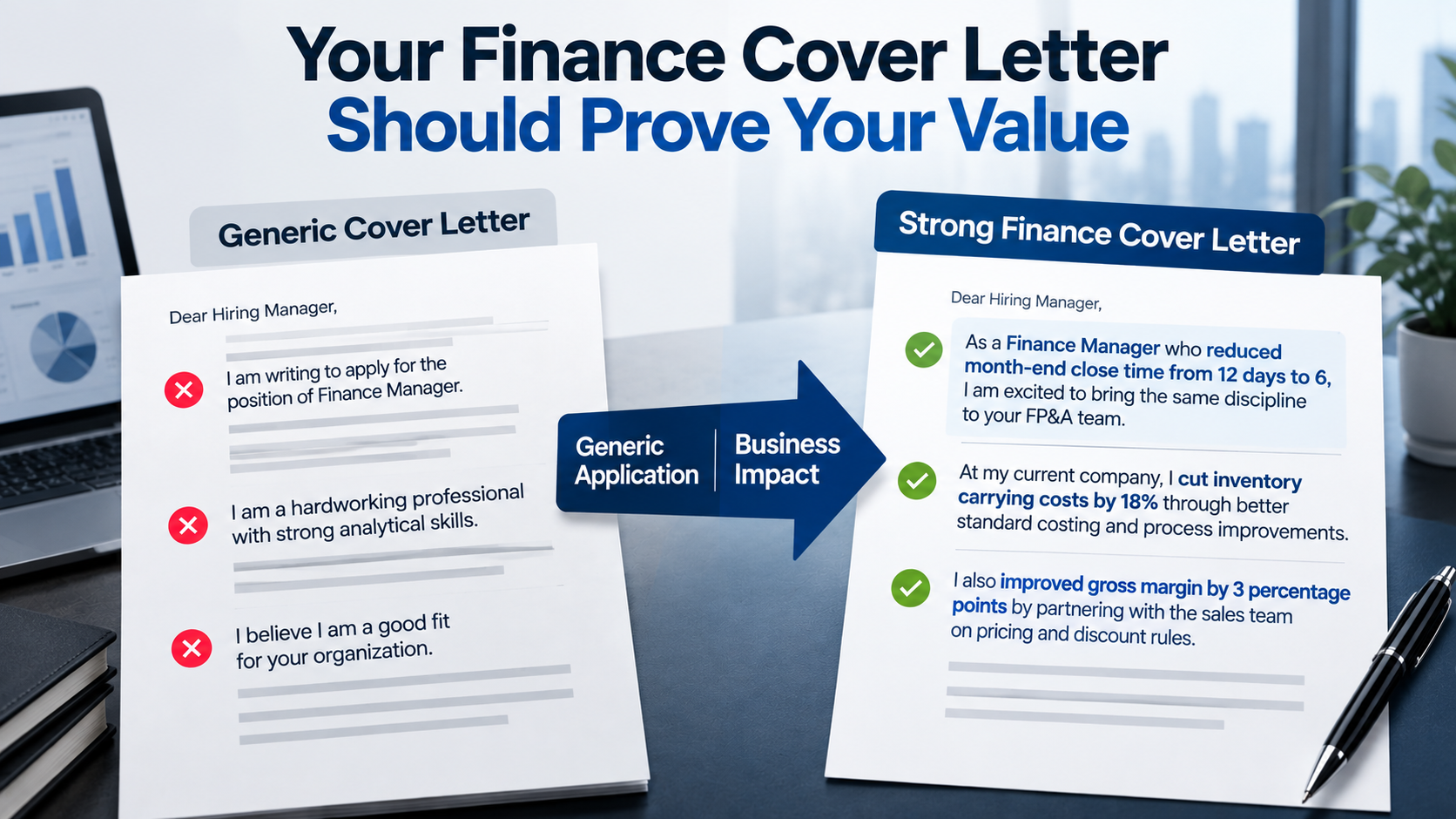
Modern CFOs want finance leaders who influence decisions, not just report on them. They look for evidence that you've sat across from sales, operations, or product leaders and changed an outcome.
Weak: "Provided financial analysis to support business units."
Strong: "Partnered with the VP of Sales to rebuild discount approval rules using margin analysis, lifting gross margin 2.3 points without reducing win rate."
Fix: For every senior role, include at least one bullet where finance analysis led to a business decision, and name the counterpart (VP Sales, COO, Head of Product) to show your seat at the table.
4. Accuracy, Controls, and Trustworthiness
Finance is a trust function. CFOs are personally accountable for the numbers, and a control failure or restatement lands on their desk first. They look for evidence that you protect them.
What signals trust on a resume:
- Clean audit outcomes (for example, consecutive audits with no material weaknesses)
- SOX or internal controls ownership, where relevant
- Remediation of prior control gaps or audit findings
- Experience with lender, investor, or board reporting where accuracy matters
Weak: "Assisted with external audit."
Strong: "Owned the external audit relationship across three annual audits; remediated two prior-year control deficiencies and delivered zero material weaknesses in the final two cycles."
5. Team Leadership and Talent Development
Above the Manager level, CFOs are hiring someone to lead people, not just process work. They want to see that you can build, develop, and retain a finance team — and that you can raise the quality of the function beyond your own output.
Weak: "Managed a team of accountants."
Strong: "Rebuilt a 9-person accounting team after 40% turnover; promoted two staff accountants to senior roles and brought voluntary attrition to zero over 18 months."
Fix: Show structure (who you hired, promoted, restructured) and outcome (retention, capability, performance), not just headcount.
6. Systems, Automation, and AI Fluency
CFOs are now expected to modernize finance, and they want direct reports who can drive that. Technical accounting knowledge is assumed; what increasingly differentiates candidates is the ability to implement and use modern tools — ERP, planning platforms, automation, and AI-assisted analysis.
Weak: "Proficient in Excel and various accounting software."
Strong: "Led migration from QuickBooks to NetSuite across three entities; built automated consolidation and variance reporting that eliminated roughly 30 hours of manual work per close."
Fix: Name systems specifically (NetSuite, SAP, Oracle, Workday Adaptive, Anaplan, Power BI) and describe what you implemented or automated, not just what you "know."
7. A Credible Career Story
CFOs read a resume as a narrative. They look for progression that makes sense: increasing scope, logical moves, and reasons behind each change.
What builds confidence:
- Titles and scope that grow over time
- Tenure that shows you stay long enough to see results (and short stints that are explained)
- Brief, factual handling of gaps or transitions
What raises questions:
- Repeated short stints with no explanation
- Lateral moves with identical bullets across roles
- Unexplained gaps at senior levels
Fix: If you have a gap or a short tenure, address it in one line ("Company acquired," "Role eliminated in restructuring," "Fractional Controller engagements during this period") rather than leaving the CFO to guess.
8. Clear Communication on the Page
Your resume is your first writing sample. CFOs present to boards, lenders, and investors, so they notice whether you can communicate clearly and concisely.
What CFOs respond to:
- A tight summary that states who you are, your scope, and one headline result
- Consistent formatting, standard section headings, and clean layout
- Two pages maximum for senior roles, with older experience summarized
What turns them off: buzzword-heavy summaries ("results-driven finance leader with a proven track record"), dense paragraphs, and inflated language that doesn't survive a first interview question.
Weak vs Strong: A Quick Comparison
| What the CFO is asking | Weak resume answer | Strong resume answer |
| Have you worked at my scale? | Title only | Revenue, entities, team size, systems |
| What did you actually change? | Duties list | Quantified outcomes |
| Can you influence the business? | "Supported business units" | Named partner, decision, result |
| Can I trust your numbers? | "Assisted with audit" | Audit outcomes, controls remediation |
| Can you lead people? | "Managed a team" | Team built, developed, retained |
| Can you modernize finance? | "Proficient in Excel" | Systems implemented, work automated |
| Does your story make sense? | Unexplained gaps or moves | Clear progression, brief explanations |
Red Flags CFOs Notice Immediately
- No scope indicators. The CFO can't tell if you've operated at their scale.
- Identical bullets across multiple roles. It suggests you haven't grown or don't remember your own impact.
- Certifications with no context. A CPA, CFA, or MBA is valuable, but CFOs still want evidence of what you did with it.
- Overstated titles or inflated claims. Finance leaders check references, and a mismatch damages trust quickly.
- Typos, inconsistent dates, or math that doesn't add up. In a finance resume, small errors carry outsized weight because accuracy is the job.
Self-Check: Would a CFO Keep Reading?
- [ ] Each recent role states revenue, team size, entities, or systems in the first two lines
- [ ] At least 70% of bullets contain a measurable result
- [ ] I show at least one example of influencing a business decision per senior role
- [ ] I reference audit, controls, or accuracy outcomes
- [ ] I show team leadership beyond headcount
- [ ] I name specific systems and what I implemented or automated
- [ ] Any gap or short tenure is explained in a line
- [ ] My resume is two pages or fewer, with no typos
7–8 checked: Ready for a CFO's eyes. 4–6 checked: Strengthen scope and outcomes first. 0–3 checked: Start by rewriting your summary and your most recent role.
CFOs decide quickly, and they decide on scope, results, and trust. If your resume still reads like a list of duties, it's costing you conversations with the people who make hiring decisions.